What Is Divine Timing: Aligning With Your Path in 2026
You check your phone, see another engagement, promotion, move, or baby announcement, and your stomach drops a little. You start doing math on your life. Shouldn’t I be further along by now? Why does it feel like everyone else got the memo except me?
That feeling can make divine timing sound either comforting or irritating. Comforting if you need hope. Irritating if you’ve already been patient and still feel stuck.
A common interpretation of “what is divine timing” is that it means sitting still until the universe sends a giant neon sign. But that version usually leaves people more confused, not less. Real divine timing isn’t passive. It isn’t an excuse to avoid hard choices. And it isn’t a promise that everything will happen exactly when you want it to.
A more grounded way to understand it is this: sometimes life moves when your inner readiness and outer conditions finally meet. You still act. You still choose. You still grieve, plan, adjust, and show up. You just stop trying to force a result before it’s ready.
If you’ve been stuck between “trust the process” and “I need to do something,” your confusion makes sense. A lot of spiritual advice skips the practical part. So let’s make this simple, honest, and useful.
Table of Contents
- That Feeling You’re Running Out of Time
- What Divine Timing Actually Means
- Signs You Are Aligning With Your Divine Timeline
- Patience or Procrastination The Shadow Side of Waiting
- How Your Life Path Number Reveals Your Personal Timing
- Practical Ways to Tune Into Your Divine Timing
- Your Journey Your Timing
That Feeling You’re Running Out of Time
A lot of people don’t start searching for divine timing when life feels calm. They search when they’re tired of trying. A relationship won’t move forward. A job application goes nowhere. Healing takes longer than expected. You keep asking, “Am I being patient, or am I wasting my life?”
That question matters.
Sometimes the pressure comes from comparison. Your friend seems certain. Your sibling seems settled. Someone else appears to have a straight line from dream to result, while your path feels like detours, pauses, and silence. It’s easy to assume the problem is that you’re behind.
But “behind” is often just what life feels like when your path doesn’t match the pace you imagined.
When forcing stops working
Think about the seasons when you’ve pushed hard. You made the plan, did everything “right,” and still hit resistance. Then later, sometimes after you’d loosened your grip a little, the right conversation happened, a missing piece appeared, or your own clarity finally caught up with your desire.
That doesn’t mean effort is useless. It means timing is more than effort.
You can be sincere, disciplined, and ready to move, and still need one more inner shift or one more real-world condition before a door opens.
A better frame than waiting around
The most helpful way to approach divine timing is not “sit back and hope.” It’s pay attention and participate. Keep your eyes open. Notice what keeps repeating. Notice where things feel blocked for a reason and where they begin to soften.
In real life, this looks ordinary. You update the resume, but you also admit the career path no longer fits. You want love, but you stop chasing people who keep sending mixed signals. You pray for clarity, then have the honest conversation you’ve been avoiding.
Divine timing becomes useful when it helps you work with life instead of fighting every current in it.
What Divine Timing Actually Means
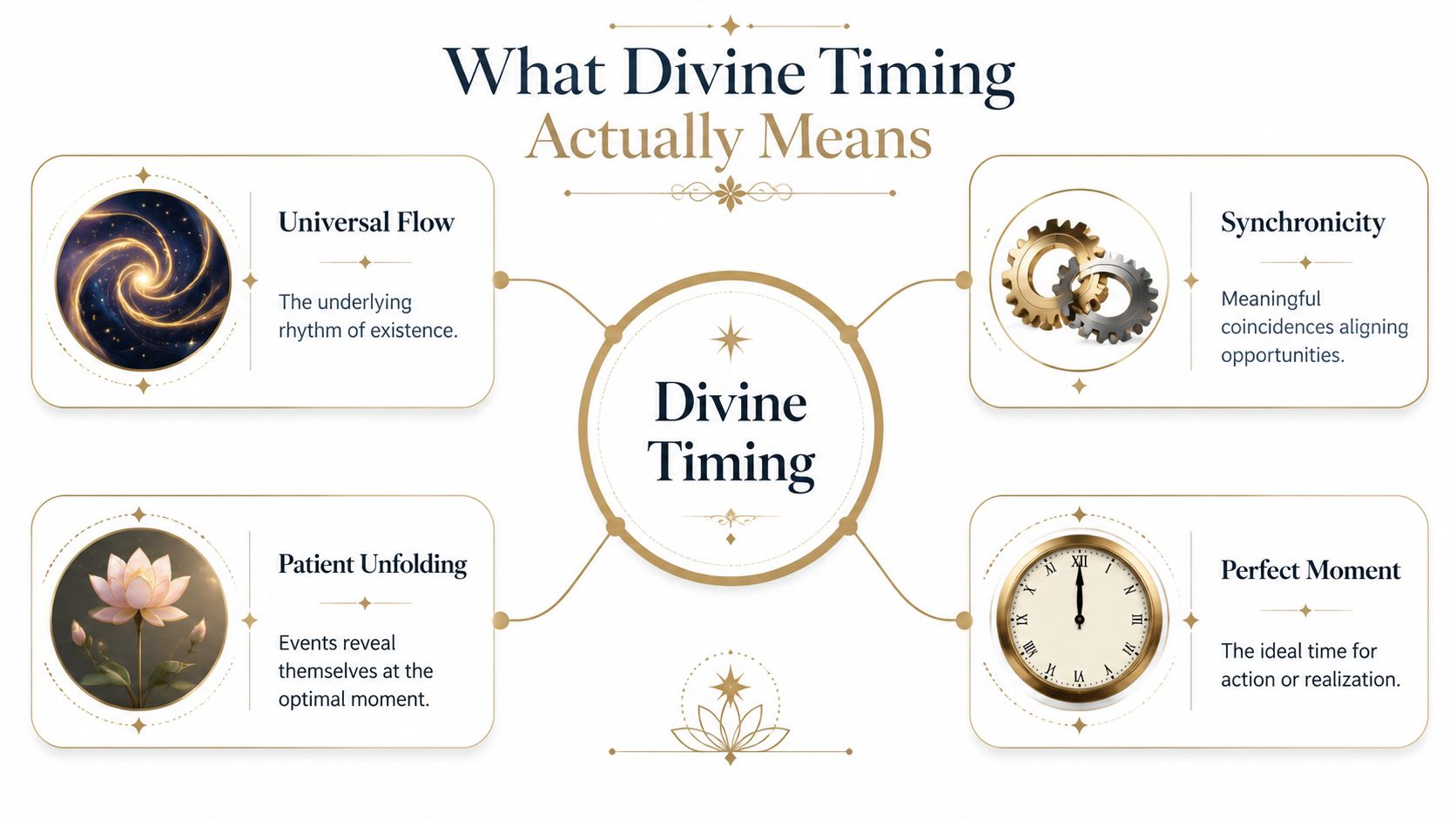
Divine timing means that events unfold through alignment, not just through a clock. In one spiritual framework, divine timing is described as the alignment between intention and conditions rather than a fixed schedule, and it contrasts human time, which is measurable and uniform, with a more energy-based process focused on the “one step” available right now, rather than forcing a whole chain of steps too early, as explained in this exploration of divine timing and human time.
That can sound abstract, so let’s make it human.
Human time versus deeper timing
Human time says, “I’m 32. I should have this by now.” Or, “I’ve been doing this for six months. It should be working.” Human time loves deadlines, comparisons, control, and proof.
Divine timing asks different questions:
- Are you ready for what you’re asking for?
- Does the situation have what it needs to hold the next step?
- Are you trying to jump ahead because uncertainty feels uncomfortable?
Bread needs time to rise. A flower can’t bloom because you stared at it impatiently. If you pull it open early, you don’t get a faster blossom. You get damage.
That’s the heart of it. Some things can be built through discipline alone. Other things need ripening.
It’s not giving away your power
People get confused here because they hear “trust timing” and assume it means surrendering all responsibility. It doesn’t. Divine timing isn’t about becoming passive. It’s about knowing when action is aligned and when action is just anxiety in motion.
You still make the call. You still leave the draining situation. You still learn the skill, say the truth, and take the meeting. But instead of trying to control every outcome, you focus on the next honest move.
Practical rule: If you need to force five future steps at once, you’re probably out of alignment. If you can clearly see the next real step, start there.
The simple definition to keep
If you want one plain-language answer to “what is divine timing,” use this:
| Idea | What it means in daily life |
|---|---|
| Readiness | You've grown into the next step emotionally, practically, or spiritually |
| Conditions | The people, resources, or context can now support movement |
| Discernment | You stop pushing every door and start noticing which one is actually opening |
Divine timing isn't magic in place of action. It's action guided by reality, self-awareness, and trust.
Signs You Are Aligning With Your Divine Timeline
When people talk about divine timing, they often make it sound dramatic. In reality, the signs are usually quiet. They show up in patterns, small openings, and a sense that life is meeting your effort instead of resisting every inch of it.
Some spiritual practitioners describe this as a convergence of internal readiness and external support, where signs include doors opening, resources aligning, and the right people showing up, as noted in this piece on signs your divine timing is already in motion.

Meaningful coincidences start stacking up
You've been thinking about a career shift, and three different people mention the same field in one week. You journal about needing support, and an old contact reaches out. You keep hearing the same message in different forms until you can't ignore it.
These moments are often called synchronicities. They aren't always proof of a final answer. But they can act like breadcrumbs.
If you struggle to tell the difference between fear and inner knowing, this guide on how to listen to your intuition can help you sort through what your inner voice sounds like.
Things still take effort, but not constant forcing
Alignment doesn't mean easy in the lazy sense. It means cleaner effort.
You still work. You still feel stretched. But the process stops feeling like you're dragging a locked door across concrete. There's movement. Conversations progress. Your energy isn't leaking everywhere.
A simple way to notice this is to ask whether you're building momentum or just generating stress.
- Aligned effort feels focused. You know what matters today.
- Forced effort feels frantic. Everything feels urgent, and nothing lands.
- False waiting feels frozen. You keep “trusting timing” without making contact with reality.
Sometimes this period overlaps with a larger life threshold. If things feel unstable, emotionally intense, or strangely clarifying all at once, you may relate to these signs of a major life transition.
People and support show up at the right moment
One of the clearest signs of timing is relational. The therapist recommendation appears when you're finally ready to heal. The mentor answers the question you've been circling for months. The job lead arrives after you admit the old role has ended emotionally, not just professionally.
This doesn't mean every new person is “the sign.” It means support starts matching your actual season.
Sometimes alignment looks less like fireworks and more like the right help arriving when you're finally willing to receive it.
You feel clearer inside, even before the full outcome arrives
This sign surprises people. External proof may still be incomplete, but inside, the panic eases. You stop bargaining with life. You may not know the whole path, but you know your next honest move.
That inner quiet matters.
It often shows up after confusion, not before it. You cry, admit the truth, let go of a fantasy, and then something settles. Not because everything is fixed, but because you're no longer fighting what's real.
Patience or Procrastination The Shadow Side of Waiting
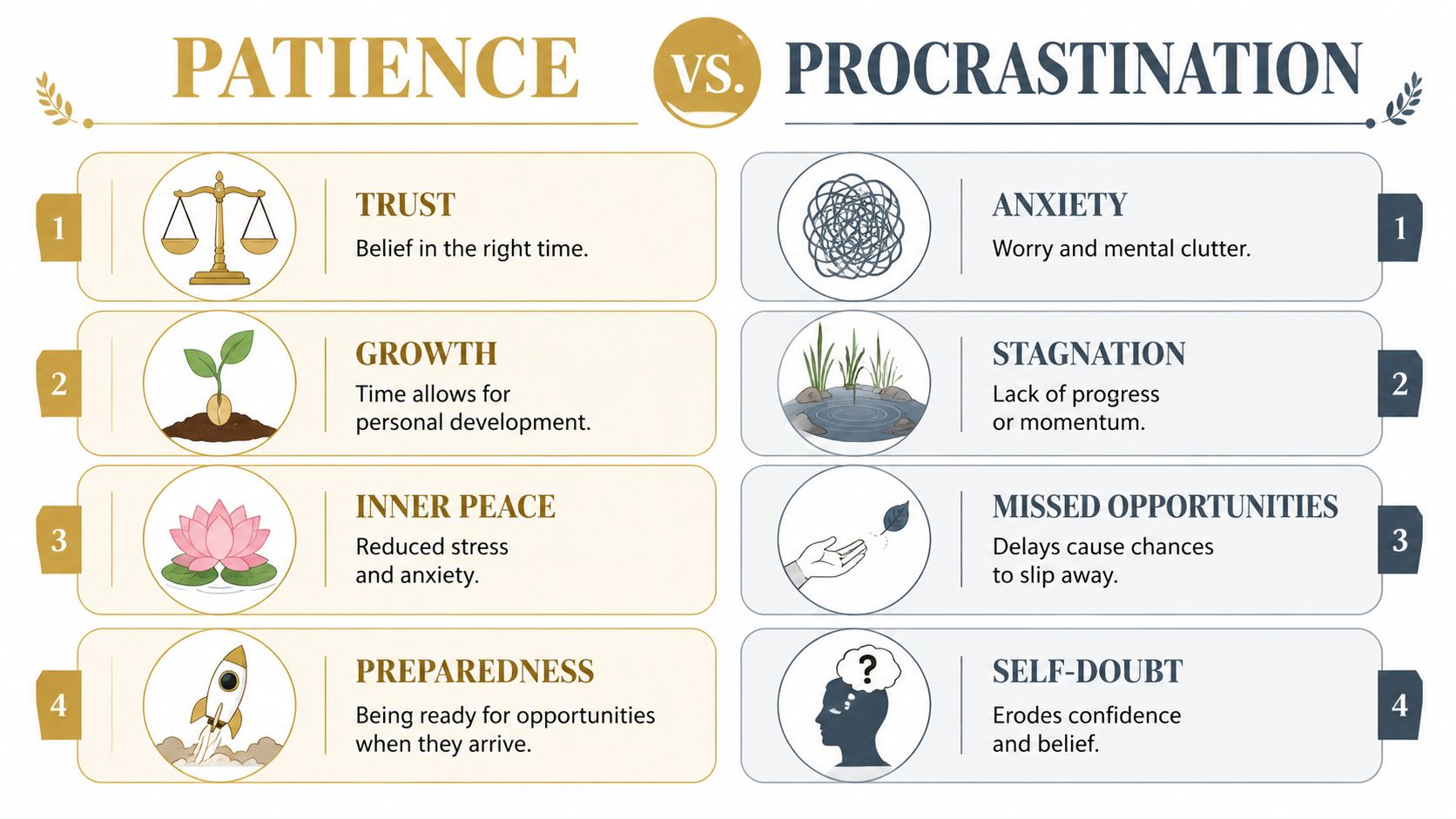
The conversation becomes real at this point. Sometimes people use divine timing wisely. Sometimes they use it to avoid action, grief, boundaries, or change.
That doesn't make you weak. It makes you human.
Many spiritual articles describe divine timing in reassuring ways, but they often don't help people distinguish trust from avoidance. A more nuanced view connects repeated waiting to personal patterns, suggesting that chronic delay can reflect fear or control rather than a cosmic pause, as discussed in this article on divine timing and avoidance patterns.
What healthy waiting looks like
Healthy patience is active. You're not frozen. You're participating.
Maybe you're healing after heartbreak, so you're not rushing into another relationship. But you are going to therapy, being honest about your patterns, and practicing better boundaries. Maybe you're waiting on a job change, but you're still networking, updating your portfolio, and learning what kind of work fits you now.
Healthy waiting has movement inside it.
- You stay honest. You admit what hurts and what's unclear.
- You take the next available step. You don't demand the full blueprint first.
- You let reality teach you. If something keeps not working, you don't keep romanticizing it.
What avoidance dressed up as spirituality looks like
Avoidance sounds spiritual because it uses soft language. “I'm just trusting.” “I'm waiting for clarity.” “If it's meant to be, it'll happen.”
Maybe. But maybe you're terrified.
Avoidance often has a distinct emotional texture. You keep circling the same decision. You refuse to gather real information because it might disappoint you. You call it surrender, but your body feels anxious, suspended, and secretly dependent on a perfect outcome.
Here's a quick comparison:
| Pattern | What it sounds like | What it often feels like |
|---|---|---|
| Healthy patience | “I'm giving this room while I keep showing up.” | Steady, open, grounded |
| Avoidance | “I can't act until I get a flawless sign.” | Tight, fearful, stuck |
| Control disguised as faith | “I trust timing, as long as it looks exactly how I want.” | Hypervigilant, attached, exhausted |
If “trust” keeps you from having a necessary conversation, making a clean decision, or grieving what's gone, it may not be trust.
A simple self-check
Ask yourself these questions and answer them without trying to sound spiritual:
- What action am I avoiding right now?
- What feeling would I have to face if I stopped waiting?
- Do I want divine timing, or do I want a risk-free guarantee?
- Have I mistaken confusion for permission to stay still forever?
If your answers bring up fear, sadness, or loss, that's not failure. It's useful information. Sometimes divine timing asks for action. Sometimes it asks for surrender. Often it asks for both.
The honest test is simple. Are you becoming more truthful, more available, and more responsible while you wait? If yes, patience may be serving you. If not, waiting may be hiding you.
How Your Life Path Number Reveals Your Personal Timing
People don't struggle with timing in the same way. One person pushes too fast. Another waits too long. Someone else confuses loyalty with delay. That's why timing work becomes more useful when it gets personal.
Numerology offers one way to notice these patterns through your Life Path number, which reflects your natural energy, growth edges, and recurring lessons. If you don't know yours yet, you can learn the process through this guide on how to calculate your Life Path number.

Why timing feels easy for some people and hard for others
A person with a naturally initiating style may struggle to let life unfold. They want movement now. They see waiting as weakness. Their lesson with divine timing may be trust, restraint, and learning that not every delay is a dead end.
Another person may be sensitive, relationship-centered, or profoundly attuned to harmony. Their challenge may be the opposite. They wait for everyone else to be comfortable. They postpone decisions because they fear disappointing people. Their timing lesson may be courage and clean endings.
This is why generic advice can feel so off. “Take action” helps the chronic hesitator. “Let go” helps the chronic controller. The same spiritual sentence won't land the same way for every nervous system or personality pattern.
A few Life Path patterns to watch
These examples aren't boxes. They're mirrors.
- Life Path 1 often learns through initiative. The shadow can be overcontrol. If this is your pattern, divine timing may ask you to stop forcing outcomes just because you can generate momentum.
- Life Path 4 often values structure, effort, and clear plans. The shadow can be rigidity. Timing lessons may appear when life refuses to follow the expected sequence.
- Life Path 6 often carries care, responsibility, and relational devotion. The shadow can be overfunctioning or staying too long. Timing may involve knowing when nurturing has turned into self-abandonment.
- Life Path 7 often seeks meaning, depth, and inner truth. The shadow can be isolation or analysis paralysis. Timing may ask for grounded action instead of endless interpretation.
- Life Path 9 often feels called toward compassion and completion. The shadow can be difficulty releasing old roles, stories, or people. Timing work may center on letting endings be endings.
Your timing pattern usually lives where your gift and your fear touch each other.
What makes this useful is not prediction. It's recognition. If you know your usual distortion, you can stop calling it fate. You can work with it consciously.
For one person, that means slowing down enough to listen. For another, it means moving before certainty arrives. Divine timing becomes easier to trust when you know the shape of your own habits.
Practical Ways to Tune Into Your Divine Timing
Understanding the idea is one thing. Living it is another. If you want to work with divine timing in a grounded way, you need practices that bring you back to reality, self-awareness, and honest movement.

Journal for the next step, not the whole map
A lot of anxiety comes from demanding a complete answer. Try asking smaller questions.
Write these in a journal:
- What am I trying to force right now?
- What do I already know, but keep avoiding?
- What is the next honest step, even if it's small?
- What outcome am I too attached to?
This kind of journaling shifts you out of fantasy and into contact with what's true. That's where timing becomes clearer.
Review your own timing history
Your life has probably already taught you something about timing. Many individuals just don't stop long enough to see it.
Pick three past events. A relationship, a move, a job, a healing season. Then reflect on these:
- What did I want to happen, and when?
- What happened?
- What became clear later that I couldn't see at the time?
- Where did force create more friction?
- Where did patience help me mature?
This exercise helps you develop discernment, not blind faith. It also builds what some people call practical wisdom. If that phrase speaks to you, this reflection on what practical wisdom means in daily life offers a grounded companion idea.
A short teaching can help you settle into this mindset:
Use grounded tools to check your perspective
Spiritual timing gets blurry when you're overwhelmed. That's why practical tools matter.
Try this short routine once a week:
| Check-in | Question |
|---|---|
| Body | Do I feel open, contracted, restless, or numb when I think about this situation? |
| Reality | What facts are in front of me right now, not just what I hope for? |
| Action | What small step would respect both trust and responsibility? |
If you work with numerology, this can also be a good moment to review your current themes and ask whether your season is calling for initiation, patience, cleanup, or release.
The point isn't to become mystical about every choice. The point is to become honest, observant, and responsive.
Your Journey Your Timing
Divine timing has lasted as a spiritual idea for a long time because it speaks to something people keep living through. The Book of Ecclesiastes, traditionally dated to the 3rd century BCE, says there is “for everything there is a season, and a time for every matter under heaven,” which means this trust in a higher rhythm has been part of spiritual reflection for more than 2,300 years, as noted in this discussion of the roots of divine timing.
What matters most, though, isn't sounding spiritual about timing. It's learning how to live it with integrity.
That means trusting without disappearing. Acting without forcing. Waiting without abandoning yourself. Letting grief tell the truth when something isn't yours. Letting movement begin when the next step becomes clear.
If you've been asking “what is divine timing,” the simplest answer is this: it's a relationship with life that blends responsibility, discernment, and trust. Not passivity. Not panic. Partnership.
Your path may not look like someone else's. Your pace may not match the timeline you once imagined. That doesn't mean you're late. It means your life is asking for your kind of courage, your kind of honesty, and your kind of readiness.
If you want to explore your own patterns around timing, control, gifts, and growth, The Human Life Code offers a grounded way to decode your Life Path and turn self-knowledge into practical change.