Synchronicity and Numbers: Decode their Meaning
You glance at the clock and it's 11:11 again. Later, a receipt ends in 444. Then a license plate flashes the same pattern you saw yesterday, and suddenly you're wondering if life is trying to get your attention.
That moment can feel equal parts comforting and confusing. Part of you wants to lean in and ask, “Is this a sign?” Another part rolls its eyes and says, “Or am I just noticing numbers because I'm looking for them now?”
Both reactions are fair.
Synchronicity and numbers sit right in that tender space where psychology and spirituality overlap. People often want a neat list of meanings. But the more useful question is usually this one: What do I do with the experience? If a number keeps showing up, how can you tell whether it's pointing toward genuine inner growth or instead revealing your brain's habit of finding patterns?
That's the skill worth building. Not blind belief. Not instant dismissal. Discernment.
Table of Contents
- That Feeling When a Number Follows You Everywhere
- What We're Really Talking About Is Synchronicity
- Why Your Brain Gets Hooked on Number Patterns
- Connecting Universal Numbers to Your Personal Code
- A Practical Journaling Guide for Tracking Synchronicities
- Meaningful Signal or Mental Habit? How to Tell
- Using Numbers as a Compass for Your Personal Growth
That Feeling When a Number Follows You Everywhere
It usually starts in an ordinary moment. You're tired, distracted, maybe carrying a question you haven't said out loud yet. Then a number starts repeating itself across your day.
Not once. Enough times that you pause.
Maybe it's 11:11 on your phone every time you look up. Maybe 222 keeps showing up while you're trying to decide whether to stay in a relationship, leave a job, or trust a new direction. Maybe you keep catching 333 during a week when your emotions feel louder than usual.
What makes the experience stick isn't just the number. It's the timing.
Why this feels so personal
A repeating number often lands when you're already emotionally open. You're searching, grieving, hoping, or standing at a crossroads. That inner state gives the outer event its charge. The number doesn't feel random because it arrives inside a meaningful moment.
That's why generic “angel number” lists often feel unsatisfying. They tell you what a number supposedly means, but they don't help you understand why this sighting hit you today, in that moment, with that feeling in your chest.
Sometimes the important part isn't the number itself. It's what was happening in you when you noticed it.
The real question beneath the curiosity
Many individuals aren't asking for a number dictionary. They're asking something more human.
- Am I being guided?
- Am I projecting meaning because I need reassurance?
- How do I use this without becoming superstitious?
That's where a grounded approach helps. You don't have to pick one extreme or the other. You don't have to say every number is a cosmic message, and you don't have to flatten every experience into “just coincidence.”
You can stay curious. You can test what you notice. And you can let synchronicity and numbers become a tool for self-awareness instead of a trap of over-interpretation.
What We're Really Talking About Is Synchronicity
The word synchronicity sounds mystical, but the core idea is surprisingly simple. It points to an event that feels meaningful even though there's no obvious chain of cause and effect connecting it.
Carl Jung developed the concept of synchronicity in the early 20th century with physicist Wolfgang Pauli, defining it as a “meaningful coincidence” between events not linked by cause and effect, a framework often used to interpret repeating numbers like 11:11 as personally significant signals rather than random noise, as described in this overview of Jung's synchronicity and repeating numbers.
A simple way to understand it
Say you've been thinking about an old friend all morning. You haven't spoken in ages. Then your phone lights up and it's them.
Could that be coincidence? Yes.
Could it still feel meaningful? Also yes.
Synchronicity lives in that overlap. It describes the moment when your inner world and the outer world seem to mirror each other in a way that feels uncannily relevant. The event matters because of its meaning to you, not because anyone can prove a physical mechanism behind it.
A lot of readers get tripped up here. They assume they must choose between “this is spiritually real” and “this is psychologically explainable.” But those don't always cancel each other out. An experience can be psychologically understandable and still personally significant.
Why repeating numbers fit the idea
Repeating numbers are a modern everyday example of this old idea. You see 11:11, 333, or 22:22, and the pattern seems to line up with something active in your life. Maybe you're asking for direction. Maybe you're recovering from heartbreak. Maybe you're finally being honest with yourself.
On a practical level, number synchronicity often works like a mirror. The same clock time can appear twice a day on a 12-hour clock, but whether you notice it, remember it, and assign meaning to it depends on your timing, context, and personal state.
Here's a helpful way to hold it:
| Experience | Possible meaning |
|---|---|
| You see a repeating number once and forget it | Probably just part of daily life |
| You see it during an emotionally charged moment | Your attention and meaning-making wake up |
| You keep seeing it and reflecting on the same issue | It may be acting like a prompt for inner work |
Practical rule: Treat synchronicity first as an invitation to pay attention, not as an instruction you must obey.
That keeps you grounded. It leaves room for wonder without handing your judgment over to every digital clock.
Why Your Brain Gets Hooked on Number Patterns
Your brain is not broken because it notices patterns. That's one of its main jobs.
When people start seeing repeating numbers, they often worry they're either becoming irrational or becoming specially chosen. Usually, neither is true. You're watching a very normal mental process become visible.
Your mind is built to notice patterns
Humans naturally look for order in the world. That tendency helps you read faces, detect danger, learn language, and make sense of messy situations. But it also means you can start spotting patterns in random or ambiguous material.
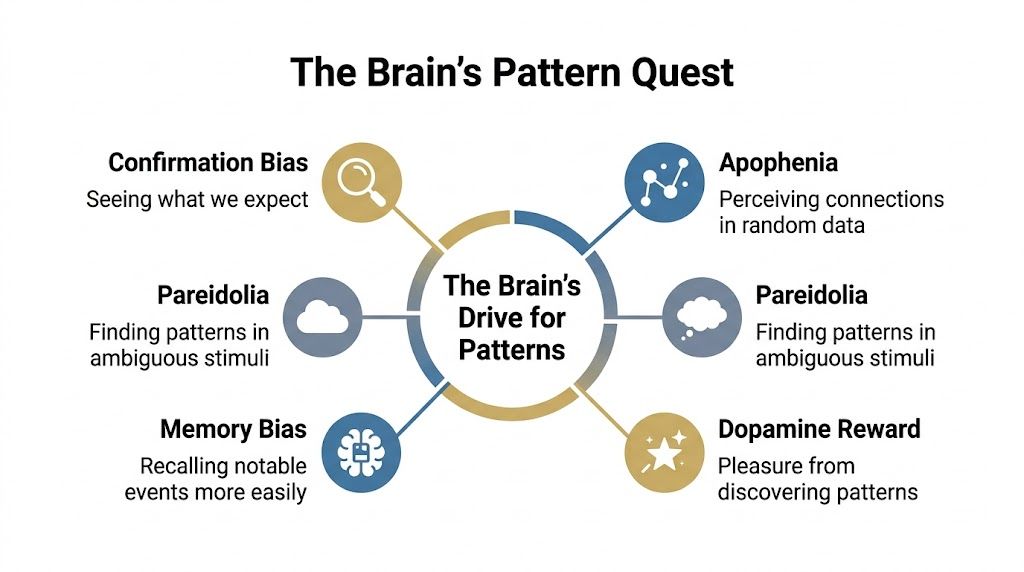
Research on apophenia shows humans are more likely to perceive meaningful patterns in random data when under stress or uncertainty. That means you might notice more signs like 11:11 when you're already searching for answers, which makes it worth asking whether the pattern is a message or a reflection of your emotional state, as discussed in this apophenia and pattern perception explainer.
A few common mental habits shape this:
- Confirmation bias helps you notice what fits what you already expect.
- Memory bias makes the striking sightings easier to remember than the many unremarkable ones.
- Emotional intensity can make a pattern feel charged and unforgettable.
That doesn't make the experience fake. It means your inner state is part of the event.
A short visual can help anchor these ideas:
Probability creates strange moments all the time
Some coincidences feel rare because your intuition about probability is often off. The classic example is the birthday problem. In a room of just 23 people, there's already a greater than 50% chance that two people share a birthday, and with 70 people the chance rises to 99.9%, as explained in Aeon's discussion of coincidence, the birthday problem, and the law of truly large numbers.
That's wild, but it makes an important point. Events that seem unlikely can become common when there are enough opportunities for them to happen.
So when millions of people check clocks, receipts, addresses, and license plates every day, repeated number patterns will show up often somewhere. Probability guarantees plenty of odd little alignments.
The question isn't only “How likely was this?” It's also “Why did this one matter to me?”
That's the bridge between statistics and self-reflection. Probability explains why patterns appear. Meaning explains why one of them lands in your life with force.
Connecting Universal Numbers to Your Personal Code
A repeating number and your core numerology aren't the same thing. Many often confuse these distinct concepts.
A number you keep seeing in the world can act like a nudge. The numbers tied to your birth date and name point more toward a blueprint. One is situational. The other is personal.
A repeating number is a nudge
In numerology practice, repeated digit sequences are often treated as intensity markers. Kripalu's guide says that “the more repeating numbers in a string, the more powerful the message,” and gives examples such as 111 as a manifestation cue and 888 as completion and transition in this guide to synchronicity numbers and repeated sequences.
That can be useful if you approach it lightly.
If you keep seeing 111, you might ask whether your thoughts are scattered or focused. If 888 appears during a season of endings, you might reflect on what is completing in your life. The number becomes a prompt, not a prophecy.
A simple distinction helps:
| Type of number experience | How to use it |
|---|---|
| Repeating numbers you notice during the day | Reflect on current themes, choices, or emotions |
| Numbers rooted in your birth date or name | Explore long-term patterns, gifts, and growth edges |
Your personal numbers are the blueprint
Numerology becomes more grounded. Instead of asking, “What does 222 mean for everyone?” you start asking, “How does this sighting interact with who I already am?”
Your Life Path Number is often treated as a core pattern in your life story. Some people also explore an Expression Number through their name to understand how they naturally move through the world. These numbers don't replace your judgment, but they can give context to the repeating patterns that catch your eye.
For example, if you're in a period of major transition and you keep noticing a number associated with trust or completion, that message may land differently depending on your deeper themes. That's why it helps to first calculate your Life Path Number step by step and understand your own baseline.
Instead of collecting random messages from the outside, you begin reading synchronicity and numbers in relation to your inner design.
- Universal number meaning can suggest a broad theme.
- Personal numerology can tell you why that theme keeps pressing on you.
- Real discernment comes from combining both with honest self-observation.
Used this way, numbers become less about magical decoding and more about precise reflection.
A Practical Journaling Guide for Tracking Synchronicities
If you want clarity, don't rely on memory alone. Write things down.
A journal turns number sightings from vague vibes into observable patterns. That matters because the human mind is selective. It remembers the dramatic hit and forgets the dozens of neutral moments around it.
What to record in the moment
You don't need an elaborate ritual. A notes app, paper journal, or voice memo works fine. What matters is consistency.
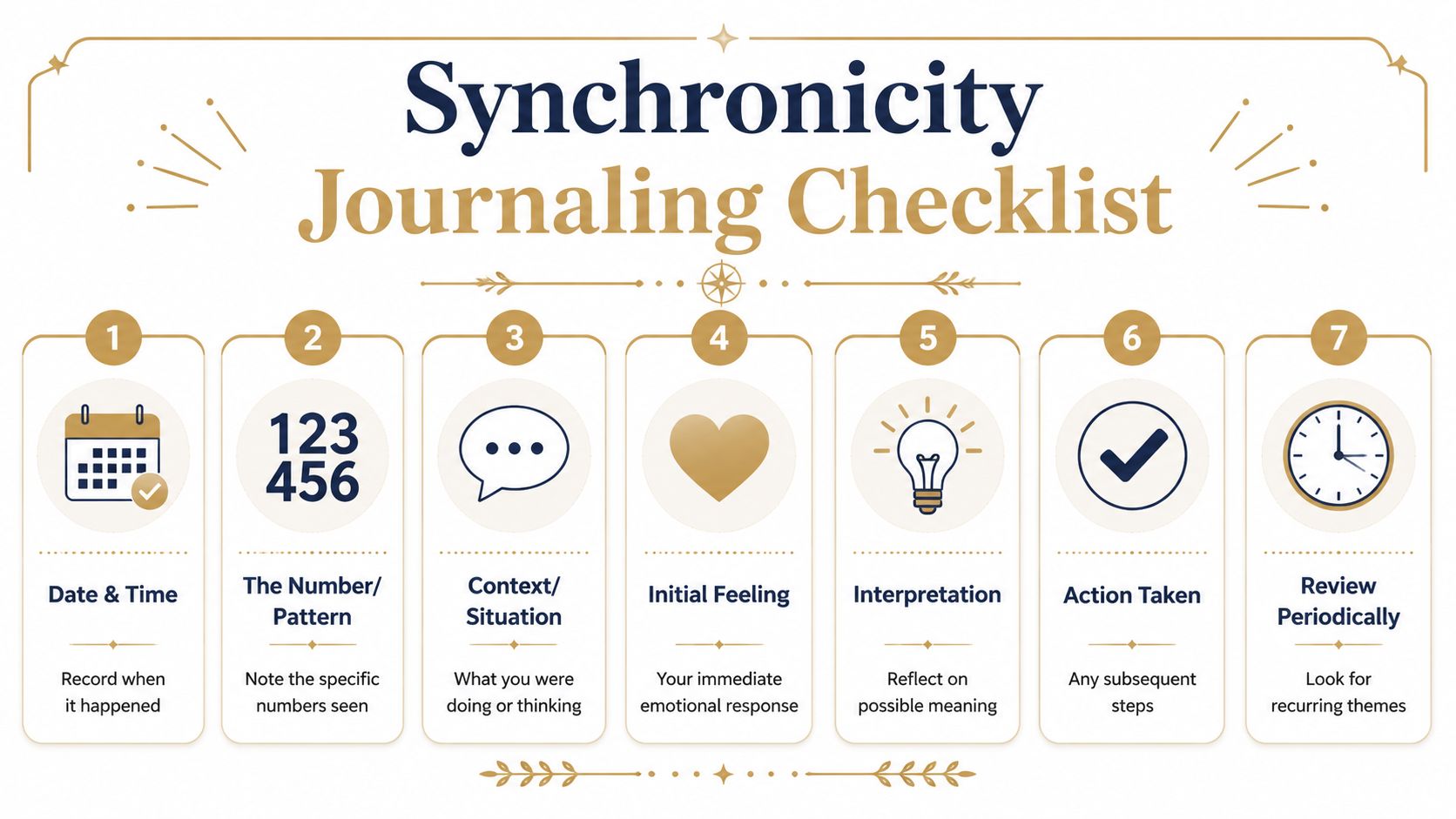
Try recording these details each time:
The number
Write the exact sequence. Was it 11:11, 222, 777, or something less obvious?Where it appeared
Clock, receipt, address, license plate, phone battery, invoice, timestamp.Your emotional state
Calm, anxious, hopeful, numb, excited, overwhelmed.What was on your mind
The thought right before the sighting is often the most revealing part.What happened next
Did the moment pass, or did it lead to a conversation, decision, or insight?
If you want help creating a more reflective writing rhythm, this guide on how to start a spiritual journal offers useful prompts without making the practice feel heavy.
How to review your entries later
The underlying value appears when you review several entries together. That's when themes start to separate themselves from isolated moments.
Use this short review process:
Look for emotional clusters
Are you seeing certain numbers mostly when you're stressed, lonely, or making decisions?Notice repeating life topics
Do the sightings gather around work, relationships, boundaries, grief, or purpose?Check for action patterns
After some sightings, do you make clearer choices? After others, do you spiral into overthinking?
Ask, “What does this pattern reveal about my attention?” before asking, “What is the universe telling me?”
That question alone can save you from turning every coincidence into a command.
A journal also helps you see when synchronicity and numbers are helping. If your entries lead to stronger self-honesty, better decisions, or deeper calm, the practice is serving you. If they lead to fixation, fear, or avoidance, the practice needs rebalancing.
Meaningful Signal or Mental Habit? How to Tell
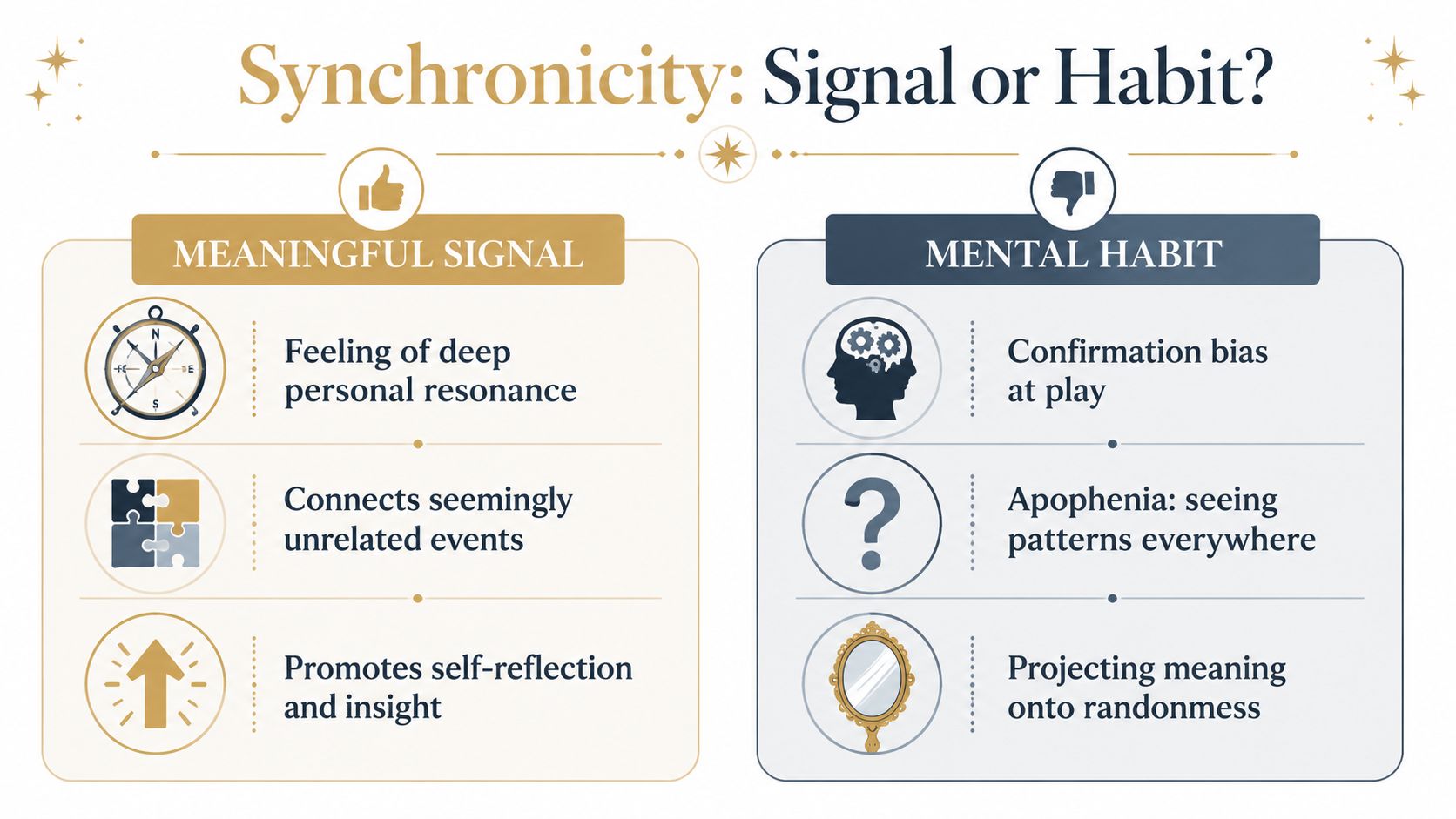
This is the part people usually want help with most. How do you tell whether a number sighting is useful or just your brain looping on a pattern?
You won't get perfect certainty. But you can get better at discernment.
Questions that sharpen discernment
Start with a few honest questions instead of a quick interpretation.
Does this happen mostly when I'm distressed?
If the sightings spike during fear, uncertainty, or urgency, your nervous system may be amplifying your pattern-seeking.Does the message invite reflection or demand obedience?
Useful synchronicity tends to open awareness. Mental habit often creates pressure.Am I noticing one number, or hunting for evidence everywhere?
There's a difference between receiving a pattern and chasing one.What was I feeling right before I saw it?
Sometimes the number spotlights an emotion you haven't named yet.
A grounded reflective practice can support this kind of thinking. If you want a broader framework for judgment and maturity, this piece on practical wisdom in everyday life pairs well with number work.
What a grounded interpretation feels like
A healthy interpretation usually feels simple, clear, and usable. It might sound like, “I keep seeing this number when I'm avoiding a hard conversation,” or “This pattern shows up when I need to slow down and trust my own timing.”
An ungrounded interpretation tends to sound dramatic or fear-based. It might push you toward magical thinking, compulsive checking, or giving your agency away.
Here's a quick comparison:
| More grounded | Less grounded |
|---|---|
| “This makes me want to reflect.” | “I must obey this sign immediately.” |
| “This connects with something real in my life.” | “Everything is a coded message about me.” |
| “I can test this insight through action.” | “I'll wait for more signs instead of deciding.” |
A meaningful sign should make you more honest and more responsible, not less.
That's the standard worth keeping.
Using Numbers as a Compass for Your Personal Growth
The most useful way to hold synchronicity and numbers is this. They are not reliable fortune-telling devices. They are mirrors.
A repeating number can draw your attention to what's already active in you. It can highlight a fear you've been avoiding, a transition you're resisting, or a truth you're finally ready to face. Used well, it brings you back into the present.
That's where growth happens.
What to do with the insight
Once a number catches your attention, ask what small action it invites. Maybe it's setting a boundary. Maybe it's sending the honest text. Maybe it's admitting you're exhausted instead of pretending you're fine.
Sometimes the next step has nothing to do with numerology itself. If your sightings keep clustering around conflict or misunderstanding, practical support matters. A grounded guide to better communication can help you turn insight into better conversations.
And if you want to move from floating symbols to a more personal framework, it helps to explore your own core pattern through a free Life Path Number calculator. That gives you a steadier reference point than chasing every number that appears in passing.
The point isn't to become obsessed with signs. It's to become more awake to yourself.
If you're ready to explore your patterns in a grounded way, The Human Life Code offers practical tools for self-discovery, including ways to calculate your core numbers and reflect on what they mean in real life. Use it as a mirror, not a rulebook, and let the insights support wiser choices, stronger boundaries, and a clearer sense of direction.