A Quiz About Life: Your Guide to Finding Real Answers
You know the moment. It's late, your tabs are a mess, and one thought keeps circling back: What am I doing with my life? So you type something like “quiz about life” into a search bar, hoping a few questions might give shape to feelings you haven't been able to name.
That impulse isn't silly. It's often the mind's way of asking for a pause, a mirror, and maybe a little direction. When life feels noisy, even a simple quiz can feel like someone finally handing you a flashlight.
The problem is that not every quiz deserves that kind of trust. Some are light fun. Some are thoughtful prompts. A smaller group can help you notice patterns, make decisions, and start changing how you live. That difference matters.
Table of Contents
- That Midnight Urge for a Quiz About Life
- What Is a Life Quiz Really
- Exploring Different Kinds of Life Quizzes
- How to Make Sense of Your Quiz Results
- From Insight to Action in Three Simple Steps
- Common Traps to Avoid on Your Journey
That Midnight Urge for a Quiz About Life
A lot of people don't go looking for a quiz about life because they're bored. They go looking because something feels off. Maybe work looks fine from the outside, but you feel flat inside. Maybe your relationships are okay, but you keep wondering why you're still restless. Maybe you've built a decent life and still catch yourself thinking, “Why doesn't this feel like mine?”
That late-night search usually comes after a long stretch of holding it together. You answer messages. You do your job. You make dinner. You keep going. Then the house gets quiet and important questions show up.
The search usually starts with one honest feeling
Sometimes it sounds like this:
- You feel behind: Everyone else seems certain, and you feel like you missed a meeting where life got explained.
- You feel split: One part of you wants stability. Another part wants meaning.
- You feel numb: Nothing is terrible, but nothing feels alive either.
Those moments often send people toward self-reflection tools. A journal. A podcast. A trusted friend. Or a quiz.
You don't usually look for answers online until your usual coping tools stop working.
That's why it helps to treat the urge with respect. The search itself is information. It tells you that your inner life wants attention.
A quiz can be a doorway, not a distraction
Of course, some quizzes are just entertainment. There's nothing wrong with that. But sometimes a simple set of questions helps you say what you couldn't say on your own.
If your search is really about buried patterns, emotional triggers, or the parts of yourself you keep avoiding, a more focused reflection tool like this shadow work quiz can offer a gentler starting point than trying to “figure your whole life out” in one sitting.
The bigger point is simple. You're not weak for wanting guidance. You're human. And if you're here, you probably don't need another vague pep talk. You need something that helps you understand what your answers are trying to tell you.
What Is a Life Quiz Really
A life quiz is often just a structured conversation with yourself. The better ones don't tell you who you are. They help you notice how you think, what you value, what you avoid, and where your energy keeps getting stuck.
That's a big shift from the old internet model of random labels and dramatic results. A thoughtful quiz about life asks better questions. It gives language to things that can feel blurry.

A quiz can be a structured mirror
Some modern self-reflection quizzes are built on established psychological frameworks rather than pure entertainment. For example, the Greater Good Science Center's Purpose in Life Quiz is based on the Claremont Purpose Scale, developed by psychologists Kendall Bronk, Brian Riches, and Susan Mangan to measure a person's sense of purpose through a standardized method, as described by the Greater Good Science Center purpose quiz.
That matters because it changes the role of the quiz. Instead of giving you a catchy label, it offers a lens. It says, “Here's one way to organize what you're experiencing.”
You can see the same idea in other kinds of self-assessment tools too. For example, someone exploring communication patterns, sensory overwhelm, or social fatigue might use an adult autism self-assessment as a first step toward understanding recurring experiences. That kind of tool doesn't replace professional care, but it can help a person ask sharper questions.
What a good quiz actually gives you
A useful life quiz usually gives you at least one of these:
- Language: It helps you name a pattern, such as drifting, overgiving, people-pleasing, or lack of direction.
- Context: It shows that your struggle has a shape. That alone can be calming.
- Next questions: It points you toward what deserves reflection, not just what sounds dramatic.
Here's a simple way to think about it.
| Type of result | What it sounds like | Why it helps |
|---|---|---|
| Label only | “You are this kind of person” | Feels satisfying for a minute |
| Lens | “You may be leaning toward this pattern right now” | Invites curiosity |
| Reflection prompt | “Notice where this shows up in your choices” | Supports growth |
Practical rule: If a quiz result makes you feel trapped, it's probably too rigid. If it makes you more curious, it's probably more useful.
The healthiest way to use a quiz about life is as an opener. Not a verdict. Not a sentence. Just an invitation to look at yourself with a little more honesty and a little less shame.
Exploring Different Kinds of Life Quizzes
Not all life quizzes are trying to answer the same question. That's where people get confused. They take a personality quiz when what they really want is career direction. Or they take a purpose quiz when what they really need is help naming their values.
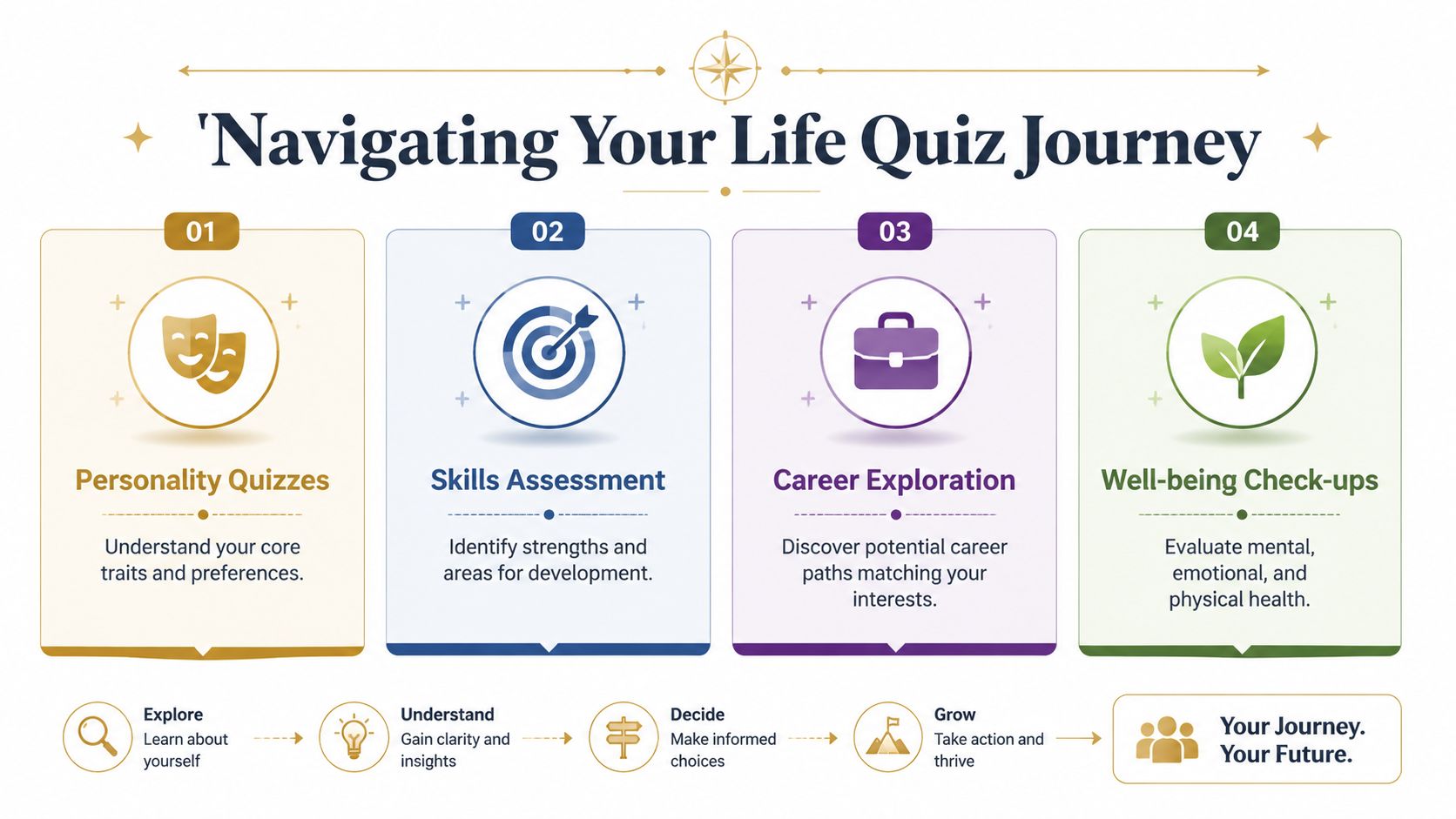
Four common paths people take
Here's a clearer side-by-side view.
| Quiz type | Core question | What it usually helps with | Blind spot |
|---|---|---|---|
| Personality quizzes | How do I tend to think and respond? | Preferences, style, communication | Can become identity boxes |
| Values inventories | What matters most to me? | Priorities, decision-making, conflict | Doesn't always explain behavior |
| Purpose quizzes | What gives my life direction? | Meaning, motivation, contribution | Can feel abstract if you need action |
| Numerology systems | What deeper patterns shape my path? | Life themes, gifts, challenges, recurring lessons | Works best when used with grounded reflection |
Personality tools can be comforting because they explain why you keep reacting the same way. Values tools are useful when you feel torn between two good choices. Purpose tools help when life feels hollow, even if everything looks successful on paper.
Numerology-based systems sit in a different lane. Instead of asking only how you behave, they look at larger life patterns and recurring themes. That’s part of why many people turn to numerology when they want a more integrated view of identity, relationships, growth edges, and timing. If you’re curious about the mechanics, this guide on how to calculate your Life Path Number shows how one core numerology pattern is derived.
A practical note if you’re designing your own reflection prompts, coaching intake, or workshop exercise. Starting with well-structured question formats helps a lot.
A quick way to choose
Ask yourself which question hurts the most right now.
- “Why do I keep reacting this way?” Try a personality-based tool.
- “Why can’t I decide?” A values inventory may help.
- “Why does my life feel empty?” Start with a purpose-focused quiz.
- “Why do the same lessons keep repeating?” A pattern-based system such as numerology may fit better.
The best quiz about life isn’t the most impressive one. It’s the one that matches the question you’re actually living.
If you pick the wrong category, the result can still be interesting, but it won’t feel satisfying. That’s not because you failed the quiz. It’s because you asked one tool to do another tool’s job.
How to Make Sense of Your Quiz Results
Getting results can feel weirdly emotional. Sometimes you feel relieved because the description fits. Sometimes you feel defensive because it fits too well. Sometimes you feel disappointed because the result sounds smaller or simpler than the ache you’re carrying.
That reaction is normal. A result lands best when you treat it as information, not identity.
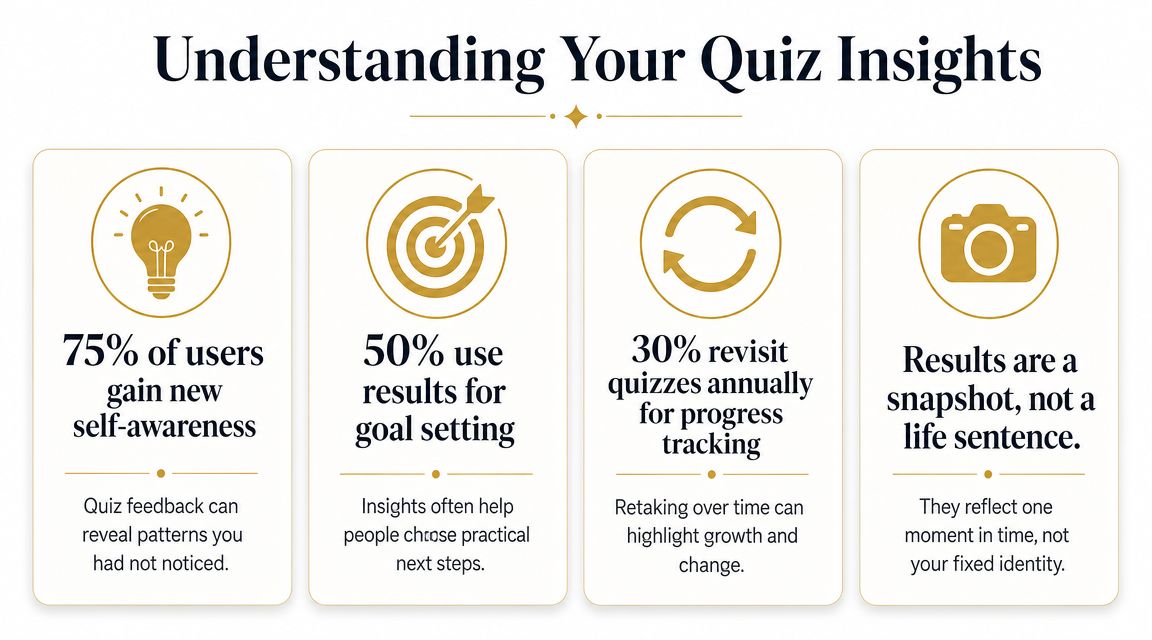
Treat results like a snapshot
Your answers reflect a moment in time. They’re shaped by your stress level, season of life, recent conflict, hope, exhaustion, and even how honest you felt safe being.
That’s why a result should act like a mirror. A mirror shows what’s present. It doesn’t tell you what must stay forever.
Try these questions after any quiz:
- What part of this feels accurate right now?
- What part feels exaggerated by stress or burnout?
- What did this result help me notice that I was avoiding?
A good result doesn’t close the conversation. It opens one.
This is also where practical wisdom matters. If you want a grounded way to think about insight, judgment, and real-life application, this piece on practical wisdom offers a helpful frame.
Life stage changes the meaning
The same quiz result can mean different things at different points in life. Feeling uncertain at one stage doesn’t always mean something is wrong. Sometimes it means you’re in a common human transition.
Research summarized by Canada Life describes a U-shaped trajectory in life satisfaction, where well-being tends to be higher in early adulthood, dips in the 40s and 50s, and rises again later in life, as explained in their curve of life quiz overview. That matters because many people take a quiz about life during exactly that dip and assume their answers reveal a personal failure.
They don’t. Sometimes they reveal a life stage.
If you’re in midlife and suddenly questioning your work, your purpose, your relationships, or your energy, that experience may be part of a broader developmental pattern. Your result still matters. It just needs context.
From Insight to Action in Three Simple Steps
A quiz result starts to matter when it changes Tuesday afternoon, not just your mood for ten minutes.
Many people know this moment. You finish a quiz, feel a sharp flash of recognition, then go right back to the same routines, the same conversations, and the same pressure points. The insight was real. It just never reached your calendar, your habits, or your choices.
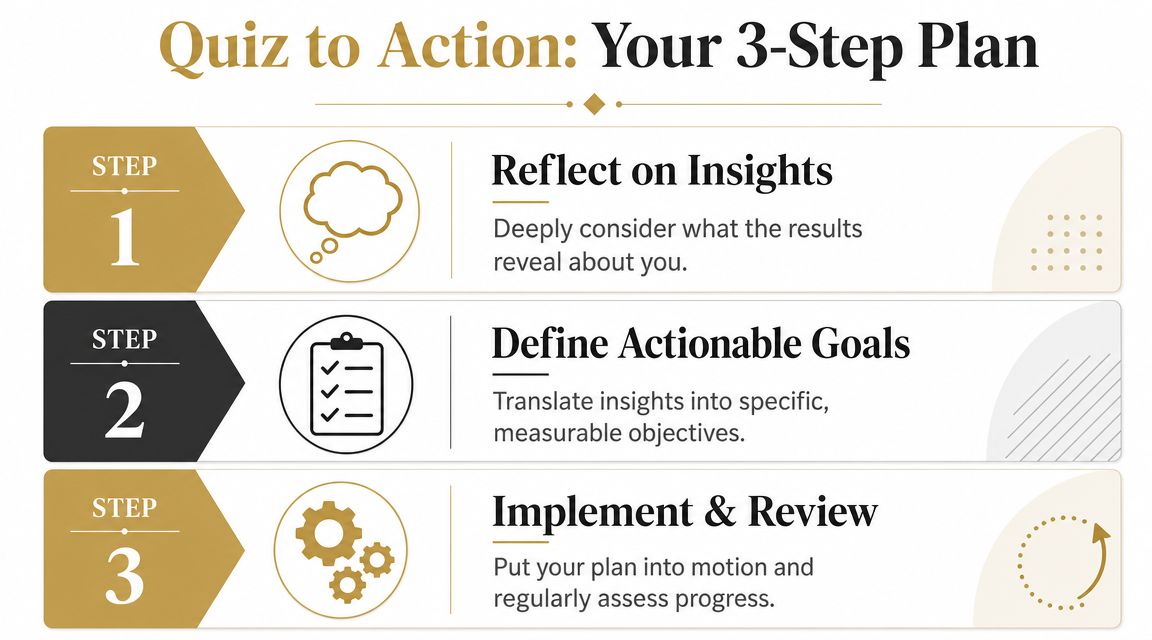
Step one, turn the result into a pattern
A quiz gives you a snapshot. Growth comes from noticing the movie.
Before you tell friends, retake the quiz, or start calling yourself by a new label, spend a few quiet minutes asking where this result shows up in ordinary life. The goal is not to judge yourself. The goal is to catch the pattern in motion, the way you would notice a draft in a room by paying attention to where the air keeps coming from.
Write for ten minutes on prompts like these:
- Where did this pattern show up in a real moment this week?
- What do I do right before this pattern appears?
- What does this pattern protect me from feeling, risking, or admitting?
That last question often opens the door. A result about indecision may be protecting you from disappointment. A result about overgiving may be protecting you from guilt. A result about feeling lost may be pointing to a part of life you have outgrown.
Step two, test one small behavior in real life
Insight gets stronger when it meets friction. You learn more from one visible experiment than from an hour of private agreement with a quiz result.
Choose one action small enough to do this week and concrete enough that someone else could notice it. If your result points to burnout, leave work on time once and protect that boundary. If it points to people-pleasing, answer one request with a clear no and no long apology. If it points to drifting, spend a focused hour on the course, application, or conversation you keep postponing.
Some tools support this better than others. The Future Life Quiz is useful here because it connects a quiz outcome to specific next moves, which is far more helpful than a flattering description with no follow-through.
A quick reset can help before you choose your action:
Step three, use a deeper map when the same lesson keeps repeating
Some quiz results fade because they captured a passing mood. Others keep returning because they point to a larger pattern underneath. When that happens, you may need more than a personality snapshot. You may need a system that helps you connect the dots across work, relationships, timing, strengths, and recurring struggles.
That is the difference between entertainment and structured self-discovery. A light quiz can spark awareness. A deeper framework can help you organize that awareness so you can use it.
The Human Life Code is one example. It uses birth-date-based numerology to outline a Life Path code, then applies it to practical reflection about strengths, wounds, relationships, career choices, and growth edges. Used thoughtfully, a tool like this does not make decisions for you. It helps you see your patterns in one place, which makes wiser action easier.
Keep the sequence simple. Notice the pattern. Try one small action. If the pattern keeps returning, use a deeper map to understand what your life may be asking you to learn.
Common Traps to Avoid on Your Journey
The self-discovery world can be helpful. It can also get slippery fast. A quiz can support growth, but it can also become another way to stay stuck while feeling productive.

When quizzes become avoidance
One common trap is taking more and more assessments instead of making one hard decision. You keep searching because searching feels safer than acting.
Another trap is confirmation bias. You favor results that match the story you already tell about yourself. If you believe you’re “just bad at relationships” or “not meant for structure,” you may cling to anything that protects that belief.
Watch for these signs:
- You keep retaking quizzes because you want a different answer, not deeper clarity.
- You use results as excuses for habits you don’t want to examine.
- You adopt a label too quickly and stop noticing your ability to change.
Don’t let a reflection tool become a hiding place.
A healthy quiz about life should make you more responsible, not less. It should increase self-understanding without shrinking your agency.
Your environment matters too
There’s another trap that doesn’t get enough attention. Many self-discovery tools focus so heavily on mindset that they ignore the world people live in.
Public health research discussed in the Unnatural Causes quiz material highlights a continuous health-wealth gradient, showing that health and life expectancy are closely tied to socioeconomic status, and that the life expectancy gap between the rich and the rest widened by 60% as inequality grew after 1980. That doesn’t erase personal responsibility. It does mean life outcomes aren’t shaped by personality alone.
So when a quiz result lands, ask two questions at once:
- What pattern in me needs attention?
- What condition around me is making this harder?
Maybe you’re not lazy. Maybe you’re depleted. Maybe you’re not failing at purpose. Maybe you’re carrying financial stress, caregiving strain, poor support, or a work environment that keeps pushing you into survival mode.
That question can make self-reflection more compassionate and more accurate.
If you want to go deeper than a one-off result, The Human Life Code offers a way to explore recurring life patterns, core challenges, and practical next steps through a structured numerology lens. It’s a useful next step for people who don’t just want a label. They want a framework they can work with over time.