Why Do I Feel Empty Inside? Reconnect & Thrive in 2026
You wake up, check your phone, answer a few messages, maybe go to work, maybe sit through classes, maybe handle your family life. From the outside, nothing looks obviously wrong. But underneath all of it, there’s this strange blankness. You’re not exactly crying. You’re not even sure you’re sad. You just feel flat, disconnected, and weirdly absent from your own life.
A lot of people land on the same late-night question: Why do I feel empty inside? What makes this feeling so unsettling is that it doesn’t always come with a clear cause. Sometimes life looks fine on paper. Sometimes you’re doing everything you’re “supposed” to do. And still, something feels missing.
If that’s where you are, you’re not dramatic, broken, or failing at life. Emptiness is often a signal. It can point to disconnection, overload, emotional shutdown, unmet needs, or a deeper loss of meaning. It can also be your mind and body asking for attention in a quieter voice than panic or grief usually use.
Table of Contents
- That Quiet, Hollow Feeling You Can’t Seem to Shake
- What Emptiness Is Really Trying to Tell You
- Temporary Funk or Something Deeper
- Small Steps to Feel More Present Right Now
- A Gentle Plan for Rebuilding Your Inner World
- Using Your Personal Code for Deeper Self-Discovery
- How and When to Ask for More Support
That Quiet, Hollow Feeling You Can’t Seem to Shake
Maybe your days have started to feel copy-and-paste. You get through them, but you don’t really feel them. You laugh when you’re supposed to laugh. You answer “I’m good” automatically. Then you get a quiet moment alone, and that hollow feeling creeps back in.
That kind of emptiness can be hard to explain because it doesn’t always look dramatic. It can show up when you’re successful, surrounded by people, or staying productive. That’s part of what makes it so lonely. You may wonder why you feel this way when your life seems “fine enough.”
If that lands hard, pause there for a second. You don’t need to earn permission to take this seriously.
What this feeling often sounds like
People describe it in ordinary, almost apologetic language:
- “I should be grateful.” But gratitude and emptiness can exist at the same time.
- “Nothing is really wrong.” Maybe nothing obvious is wrong, but something still hurts.
- “I just feel numb.” Not intensely sad. Not excited. Just muted.
- “I don’t feel like myself.” This is one of the clearest clues that your inner world needs care.
You can be functioning and still be struggling.
Sometimes the hardest part is the isolation. You may feel like everyone else got the handbook for how to be alive and connected, and you somehow missed it.
You are not the problem
Emptiness often makes people turn on themselves. They assume they’re lazy, ungrateful, too sensitive, or incapable of being happy. Usually, that’s not what’s happening. More often, your system is signaling that something important has gone quiet inside you.
That “something” might be emotion. It might be meaning. It might be connection, rest, safety, or a sense of self you’ve had to bury just to keep moving.
Whatever the reason, this feeling deserves curiosity, not shame.
What Emptiness Is Really Trying to Tell You
Emptiness is often less like a verdict and more like a dashboard light. It doesn’t tell you your whole story. It tells you to pay attention.
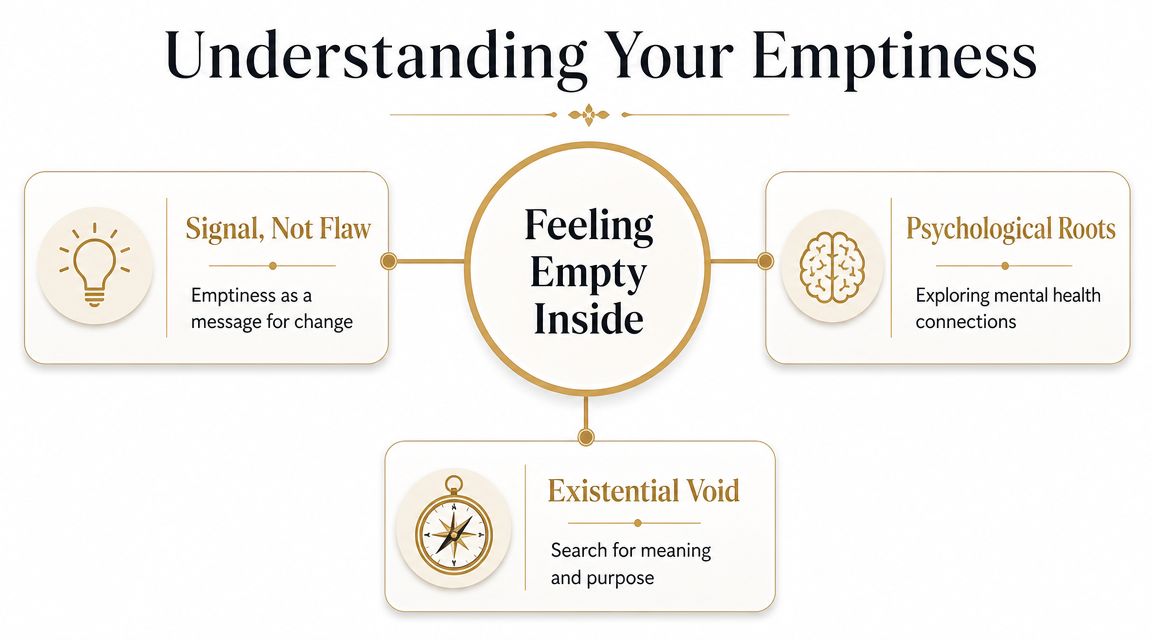
When people ask, why do I feel empty inside, they usually want one neat answer. But emptiness is often layered. It can come from emotional disconnection, from living out of step with your values, or from losing contact with what gives your life meaning.
It often starts as disconnection
One major root is simple and painful. You don’t feel fully connected to other people, or even to yourself. The U.S. Surgeon General described loneliness and isolation as a public health crisis in 2023, reporting that about half of U.S. adults experience measurable loneliness according to this summary of the loneliness data. That matters because emptiness often grows when you feel unseen, emotionally cut off, or stuck in surface-level interactions.
You can be around people all day and still feel empty. Small talk doesn’t always nourish. Being needed isn’t the same as being known. Being admired isn’t the same as being loved.
Here’s another version of disconnection that many people miss. You may have learned to hide whole parts of yourself to stay accepted. If you’re always performing, pleasing, adapting, or staying emotionally careful, life can start to feel strangely unreal.
It can also be an authenticity problem
Some emptiness shows up when your outer life and inner truth stop matching. You keep doing what looks responsible, but your choices no longer feel like yours. That gap can create a dull ache that says, “I’m here, but I’m not really living my life.”
A few clues:
| Experience | What it may be pointing to |
|---|---|
| You feel drained after most interactions | You may be masking too much |
| You hit goals but feel nothing after | Your goals may not match your values |
| You keep asking what the point is | Meaning may be missing, not effort |
If some of your emptiness connects to old relational pain, this guide on father wound healing may also help you spot patterns that affect identity and connection.
Practical rule: Don’t treat emptiness as proof that you’re defective. Treat it as information about what your life, heart, or relationships may be missing.
Temporary Funk or Something Deeper
Not every hollow day means something serious is wrong. Sometimes you’re depleted after stress, a breakup, a big deadline, caregiving, or an emotional letdown after reaching a goal. Those dips are real, but they usually have a shape. You can point to what stirred them up.
Other times, the emptiness feels broader. It doesn’t lift when the stressful event ends. Rest doesn’t quite touch it. Fun things feel flat. You keep waiting to “snap out of it,” but nothing clicks.

A passing dip usually has a shape
A temporary funk often sounds like this:
- “I’ve been under a lot of pressure lately.”
- “I know exactly when this started.”
- “I still enjoy some things, just less than usual.”
- “When I rest or connect with someone safe, I feel a little better.”
That kind of emptiness still deserves care. But it often softens as your nervous system settles and your life gets a little more supported.
Signs your system may be shutting down
Chronic feelings of emptiness are associated with emotional numbing or dissociation and reward-circuit blunting, as described in this therapist overview of emptiness. In trauma-related states, dissociation can work like a short-term protective buffer, but it can leave you feeling hollow or not fully present. The same source notes that sleep deprivation, thyroid disorders, anemia, medication effects, and substance use can also flatten emotional range and mimic emptiness.
That’s why it helps to ask yourself a few grounded questions, not to diagnose yourself, but to get clearer.
- How long has this been going on? A few rough days feels different from a persistent blankness.
- Can I still feel pleasure or warmth sometimes? If everything feels flat, that matters.
- Is it affecting my daily life? Work, school, relationships, appetite, sleep, and motivation all count.
- Do I feel absent from my own experience? Some people describe this as floating, watching life from behind glass, or moving on autopilot.
If you can’t tell whether you’re overwhelmed, shut down, or both, that confusion itself is useful information.
If your emptiness feels chronic, physically strange, or disconnected from your usual self, don’t brush it off as a personality quirk.
Small Steps to Feel More Present Right Now
When you feel empty, giant self-improvement plans can feel insulting. You do not need a whole new life by Friday. You need one small point of contact with yourself, right now.
Clinicians often recommend behavioral activation-style steps because emptiness can reflect under-activation of emotional and reward systems. Small valued actions and grounding can help increase emotional salience and reduce numbness over time, as explained in this reflection on emptiness and re-engaging behavior.
Think tiny, not impressive
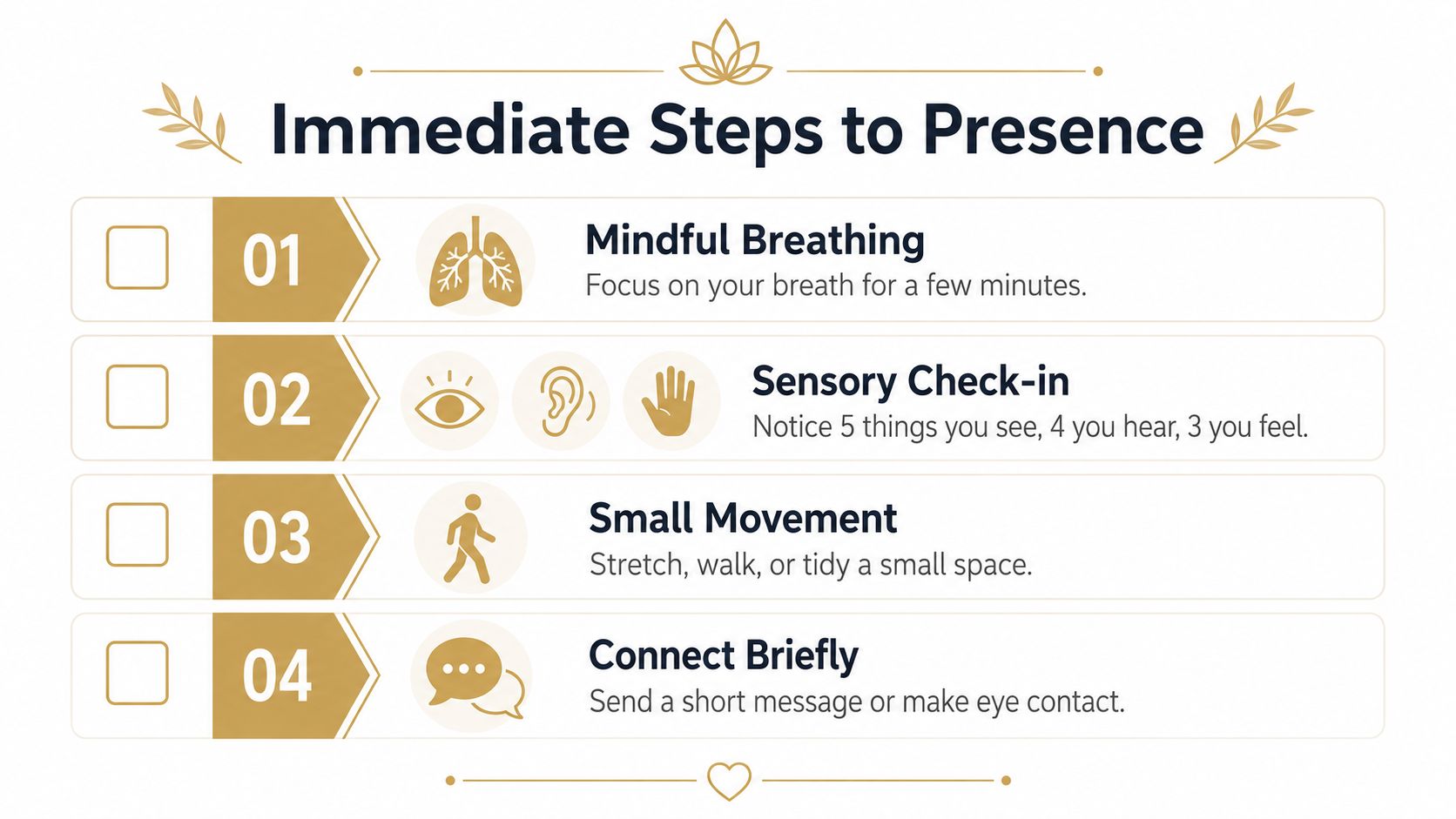
The point is not to force joy. The point is to interrupt blankness with contact.
Try one of these:
- Temperature: Hold a warm mug or rinse your hands in cool water. Focus only on the sensation.
- Air: Step outside for a minute. Notice the air on your face, even if you feel nothing else.
- Sound: Put on one song that used to move you. Don’t judge your reaction.
- Motion: Walk to the end of the block, stretch your back, or tidy one small surface.
- Contact: Send one honest text. Not polished. Just real.
Here’s a short guided resource if you want some structure while you do that:
A five-minute reset menu
If your brain goes blank when someone says “take care of yourself,” use this menu instead:
| If you feel | Try this |
|---|---|
| Numb | Hold ice, warm tea, or a textured object |
| Foggy | Name five things you see in the room |
| Restless and flat | Walk for a few minutes without your phone |
| Alone | Message one person with one honest sentence |
Don't ask, “Will this fix me?” Ask, “Will this help me feel 2 percent more here?”
These are not cures. They are doorways. Tiny ones, but they count.
A Gentle Plan for Rebuilding Your Inner World
Coping in the moment matters. But if emptiness has been hanging around for a while, you may need more than grounding. You may need a slow rebuild.
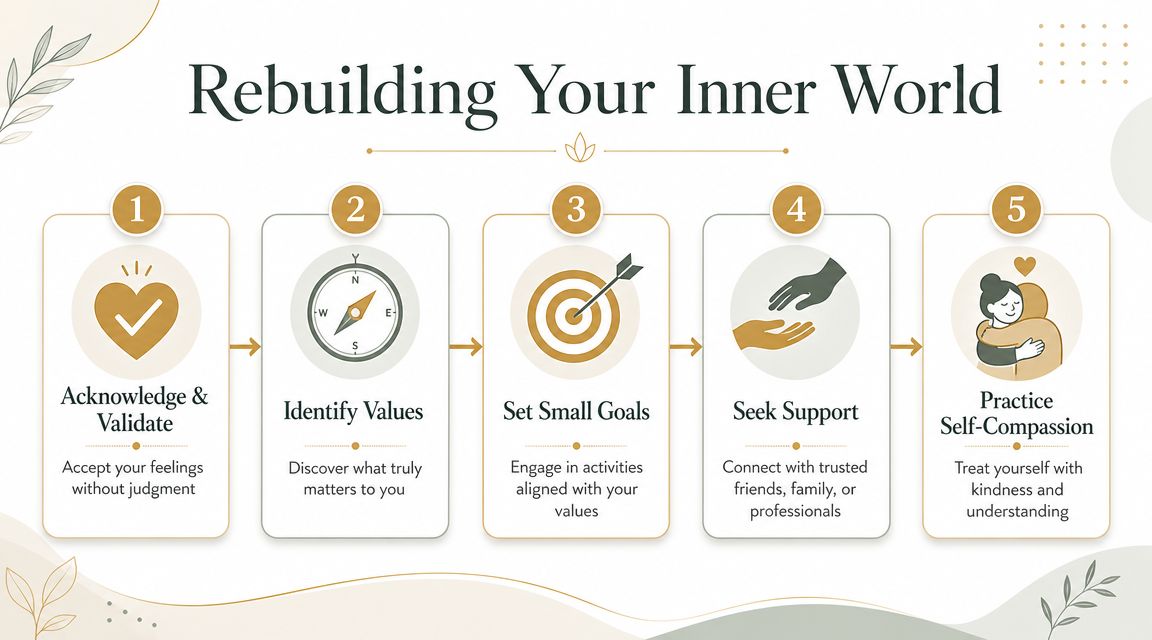
That rebuild doesn't start with becoming a brand new person. It starts with getting reacquainted with the one who's already here.
Start with your body, then your needs
A lot of people try to solve emptiness purely with thinking. But your body often knows you're disconnected before your mind can explain it.
Start here:
- Notice your body's signals. Tight chest, heavy limbs, shallow breathing, numbness, agitation. These are clues.
- Add gentle routine. Regular meals, sleep support, movement, and quieter moments can help create stability.
- Name unmet needs. Ask: Am I lonely? Exhausted? Unseen? Overcontrolled? Bored? Grieving?
This isn't glamorous work. It is foundational work.
If you want to dig into buried patterns with more honesty, these shadow work prompts for healing can give structure to your reflection without forcing fake positivity.
Make room for experiments and real connection
Once you've steadied the basics, try low-stakes experiments instead of waiting for a lightning-bolt purpose moment.
One week, try cooking something new. Another week, visit a bookstore, community class, spiritual space, nature trail, or volunteer setting. Pay attention to what creates even a flicker of curiosity, relief, or aliveness.
Then look at your relationships. Many people feel empty because they are constantly interacting, but rarely connecting.
A useful distinction:
| Surface contact | Nourishing connection |
|---|---|
| Updating people | Being honest with them |
| Being helpful | Letting yourself be known |
| Staying busy together | Sharing what's real |
You don’t need a huge social circle. You need places where you don’t have to perform so hard.
Some people also benefit from one structured self-discovery tool alongside journaling, therapy, or spiritual practice. The Human Life Code is one option. It helps people explore a Life Path code derived from their birth date and use it as a reflection framework for gifts, challenges, patterns, and purpose. Used thoughtfully, a tool like that can give language to feelings that are otherwise hard to name.
Using Your Personal Code for Deeper Self-Discovery
For some people, emptiness isn’t only about pain. It’s also about not knowing who they are anymore. They’ve spent so long reacting, surviving, pleasing, or achieving that their inner compass has gone quiet.
That’s where reflective systems can help. Not because they hand you the answer, but because they give you a place to start.
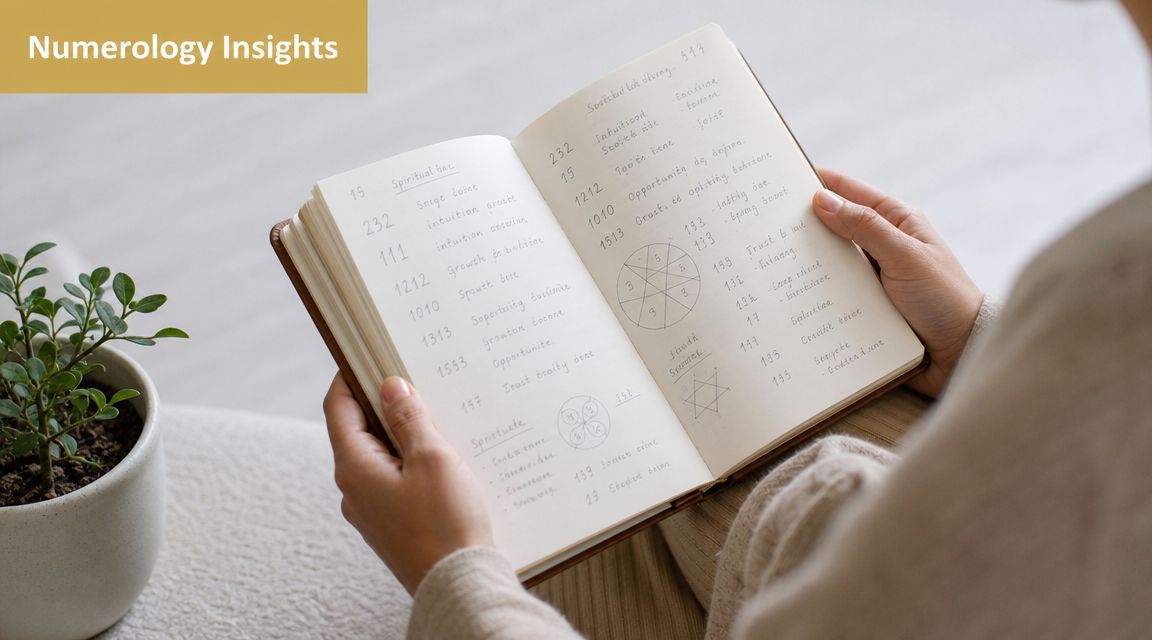
A map can calm the fog
A numerology framework, especially a Life Path lens, can work like a personal map. It can suggest themes you naturally return to, strengths you may underuse, and tensions that keep repeating in your choices and relationships.
If you’ve ever thought:
- “I keep ending up in the wrong environments.”
- “I don’t know what kind of work or life fits me.”
- “I can feel I’m off track, but I can’t explain why.”
A framework can make those patterns easier to see.
If you’re curious, you can calculate your Life Path number and use it as a journaling prompt rather than a label. The point isn’t to shrink yourself into a category. The point is to notice what resonates, what challenges you, and what helps you reconnect to your own design.
Use the tool for reflection, not prediction
This matters. A self-discovery tool should not replace your judgment, your therapy, or your lived experience. It should support them.
Used well, a personal code can help you ask better questions:
- Where do I betray myself to stay accepted?
- What kind of contribution energizes me?
- Which patterns feel familiar but empty?
- What boundaries would make my life feel more honest?
Some people need advice. Others need a mirror. A reflective framework can be that mirror.
When emptiness has blurred your identity, structure can feel calming. Not because it gives you a script, but because it helps you hear your own voice again.
How and When to Ask for More Support
Sometimes emptiness softens with rest, reflection, reconnection, and small changes. Sometimes it doesn’t. When it lingers, that doesn’t mean you’ve failed at healing. It means more support may be the wise next step.
The scale of this is bigger than many people realize. The World Health Organization states that depression affects about 280 million people worldwide, and in the U.S., the National Institute of Mental Health estimated 8.3% of adults had at least one major depressive episode in 2021, according to this summary of the data on depression and emptiness. Emptiness can be part of that picture, which is why clinicians treat it as a meaningful signal.
When self-help isn’t enough
Please take it seriously if:
- The emptiness persists for months
- You can’t feel pleasure in anything
- Your work, relationships, sleep, or daily functioning are slipping
- You feel detached from reality or from yourself
- You’re having thoughts of self-harm or suicide
If suicidal thoughts are present, seek urgent support right away through local emergency services or crisis resources in your area.
What support can look like
Support does not have to mean you’re falling apart. It can mean you’re finally choosing not to carry this alone.
That support might be:
- A therapist who helps you understand whether this is depression, grief, trauma, burnout, identity loss, or a mix
- A medical check-in if your emptiness came with major shifts in sleep, energy, appetite, or physical health
- A trusted person who can sit with the truth instead of rushing to fix it
You do not need the perfect explanation before asking for help. “I feel empty and I don’t know why” is enough to start.
If you want a grounded way to explore your inner patterns, values, and sense of purpose, The Human Life Code offers tools for self-discovery that can complement journaling, therapy, and personal reflection. It’s a practical place to explore your Life Path, recurring challenges, and the kind of life that may feel more aligned with who you are.