Why Alignment Is Important: Find Your Path & Purpose
Some seasons of life feel oddly wrong, even when nothing looks obviously broken. You get up, answer messages, meet deadlines, keep relationships going, and maybe even hit goals you once wanted. But underneath all that motion, something feels off. You’re tired in a way sleep doesn’t fix. Choices that should feel simple suddenly feel heavy. You keep wondering, “Why does this life look okay from the outside but feel so disconnected on the inside?”
That feeling is more common than widely acknowledged. It doesn’t mean you’re ungrateful, dramatic, or failing at life. It usually means something important is asking for your attention. That “off” feeling is often the first sign that your inner truth and outer life aren’t matching up.
That’s why alignment matters. When your values, energy, decisions, and direction start working together, life feels less like constant self-correction and more like forward movement. And if you’ve been craving a practical way to understand that, your Life Path number can offer a useful map.
Table of Contents
- That Nagging Feeling You Just Can’t Shake
- What Is Personal Alignment Really
- The High Price of Living Out of Sync
- 7 Telltale Signs You Are Out of Alignment
- How to Start Finding Your Way Back to You
- Your Life Path Number A Personal Alignment Compass
That Nagging Feeling You Just Can’t Shake
You might know this feeling well. You’re sitting at your desk on a Tuesday afternoon, staring at your laptop, getting things done, but feeling strangely absent from your own life. You answer the email. You make dinner. You show up for people. Still, a quiet voice keeps saying, “This can’t be all there is.”

Sometimes misalignment looks dramatic, like quitting a job, ending a relationship, or having a full identity crisis. More often, it looks ordinary. You keep functioning. You keep smiling. You keep telling yourself you should be happy because your life makes sense on paper.
That gap between “fine” and fulfilled is where a lot of people live for years.
When life fits on paper but not in your body
Maybe you chose the practical career, but your body tightens every Sunday night. Maybe you’re in a relationship with a good person, but you feel unseen in ways you can’t quite explain. Maybe you’re productive all day and still end the day with the hollow feeling that none of it was really you.
That doesn’t mean you’re broken. It means you’re receiving information.
Feeling lost is often less of a failure and more of a signal. Your life may be asking for honesty, not more performance.
Many people think they need to “fix” themselves when they feel out of sync. Usually, the deeper need is to listen. The restlessness, confusion, and low-grade frustration are often clues that your choices, pace, priorities, or environment no longer reflect who you are now.
The feeling is real, even if you can’t explain it yet
This is one reason why alignment is important. When you don’t have language for what’s wrong, you start doubting yourself. You may assume you’re lazy, indecisive, too sensitive, or impossible to satisfy. But often the issue is simpler. Your inner world and outer life aren’t cooperating.
Imagine wearing shoes that technically fit but hurt every time you walk. You can force yourself to keep moving. You can even get pretty far. But you’ll pay for it with strain, resentment, and exhaustion.
Personal alignment gives that experience a name. It helps you understand that the ache you feel isn’t random. It’s a clue that some part of your life needs to come back into right relationship with who you are.
What Is Personal Alignment Really
Personal alignment is the feeling of inner coherence. It happens when what you believe, what you need, what you choose, and how you live start matching each other more closely.
A simple way to think about it is tuning an instrument. When a guitar is out of tune, even the right song sounds wrong. The notes are there, but something grates. When it’s tuned, the music feels clear and natural. Your life works the same way.
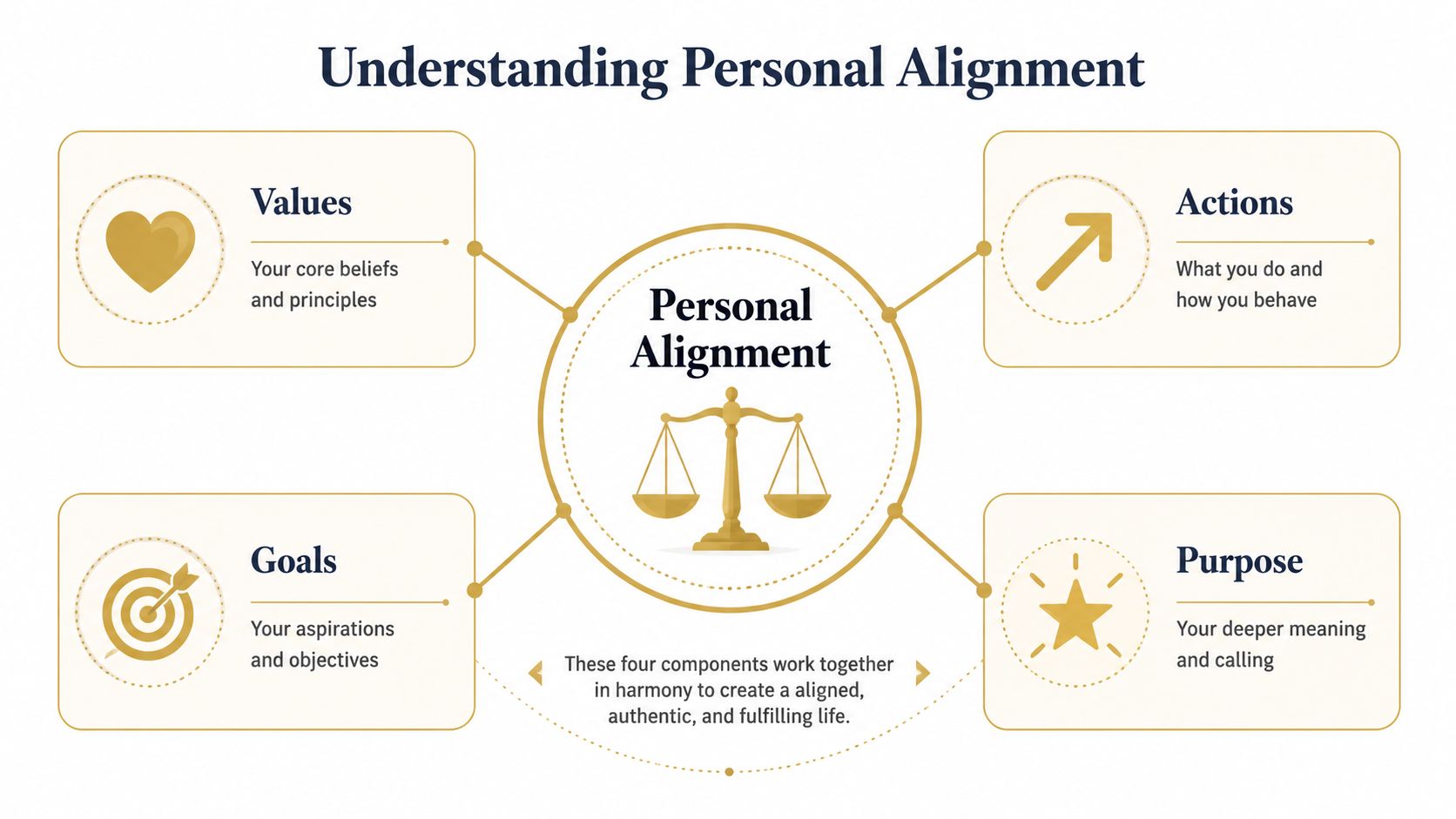
Alignment is inner truth meeting outer life
Alignment doesn’t mean every day feels easy. It doesn’t mean you never doubt yourself. It means your life is built in a way that respects your truth instead of constantly overriding it.
If you value depth but fill your week with shallow obligations, you’ll feel scattered. If you need creativity but spend all your energy conforming, you’ll feel flat. If you crave meaning but keep chasing approval, you’ll feel successful and empty at the same time.
That’s the core idea. Alignment is when your outer life stops arguing with your inner life.
Practical rule: If a choice keeps making you betray yourself, it’s probably not aligned, even if it looks impressive.
Four parts that need to work together
A lot of confusion clears up when you break alignment into parts:
| Part | What it means | What misalignment can feel like |
|---|---|---|
| Values | What matters most to you | Guilt, resentment, inner conflict |
| Actions | What you actually do each day | Numbness, procrastination, self-betrayal |
| Goals | What you’re aiming toward | Pressure, confusion, chasing the wrong thing |
| Purpose | The deeper reason you’re here | Emptiness, drift, lack of meaning |
When these parts support each other, you feel steadier. You may still work hard or face challenges, but the effort feels clean. When these parts pull in different directions, even small tasks can feel draining.
Here’s a relatable example. Someone says freedom matters to them, but they build a life around constant people-pleasing. Another person says they want peace, but they keep choosing chaos because it feels familiar. A third says they want meaningful work, yet never ask what kind of work fits their nature.
Alignment starts when you notice those contradictions without shaming yourself. Then you begin adjusting.
The High Price of Living Out of Sync
Misalignment isn’t just a vague spiritual inconvenience. It has real costs. It shows up in your energy, your relationships, your work, and your ability to make decisions you trust.

One of the clearest ways to understand this comes from organizations. According to Wilson HR’s discussion of sustaining high performance through alignment, strong alignment around common purposes and values enhances performance and coherence, while a lack of alignment causes organizations to lose efficiency and experience workforce instability, stress, and burnout. The same pattern shows up in personal life. When your values, gifts, and daily choices don’t line up, you feel fragmented.
Misalignment drains energy you can’t spare
Think about how much energy it takes to keep overriding yourself.
You say yes when you mean no. You stay in rooms where you shrink. You chase goals that don’t feel like yours. You keep explaining away your discomfort because changing course feels inconvenient or scary. None of that is neutral. It costs energy every single day.
That’s why people in misaligned seasons often feel tired before anything dramatic has even happened. Their energy is going into internal conflict.
A few common places this shows up:
- Work that looks right but feels wrong. You perform well, but your nervous system is always bracing.
- Relationships with chronic friction. You care about the person, yet you don’t feel safe being fully yourself.
- Decision fatigue. Even small choices feel exhausting because you’ve lost touch with your own signal.
- Low-grade resentment. You keep giving from a version of yourself that isn’t sustainable.
Why this turns into stress and burnout
When organizations pull in opposing directions, people burn out trying to hold the system together. Personal life works much the same way. If one part of you wants truth and another part is trained to keep the peace at all costs, your body absorbs that conflict.
This short video captures that crossroads feeling well:
You can force yourself through misalignment for a while. Many people do. But eventually, the costs become harder to ignore. You lose enthusiasm. You stop trusting your own choices. You feel both restless and stuck.
That’s a big part of why alignment is important. It isn’t about becoming perfect. It’s about stopping the ongoing leak of your attention, vitality, and self-trust.
7 Telltale Signs You Are Out of Alignment
Sometimes people know they’re unhappy, but they can’t tell whether it’s stress, a rough season, or something deeper. These signs can help you name what’s happening.
What misalignment often looks like in real life
-
You say yes when your whole body means no
You agree, volunteer, comply, and accommodate. Later, you feel irritated, drained, or privately angry. That’s often a sign you’ve abandoned your own signal to keep things smooth. -
You’re tired in a way rest doesn’t fix
This kind of fatigue comes from friction. You’re not just busy. You’re using energy to maintain a life that doesn’t fit well. -
Decision-making feels weirdly hard
Even small choices can feel loaded when you’ve been disconnected from your values. It’s hard to choose clearly when you’re no longer sure which voice inside you is the true one. -
You keep chasing validation instead of peace
If your choices feel good only when other people approve, alignment is probably shaky. External praise can’t replace internal congruence. -
You feel like you’re performing your life
You know how to look capable, kind, successful, spiritual, or “together.” But under the performance, you feel distant from yourself. -
The same painful pattern keeps repeating
Different job, same exhaustion. Different partner, same dynamic. Different goal, same emptiness. Repetition often points to a deeper mismatch you haven’t fully named. -
You spend more energy cleaning up than creating
In business, misaligned data can force teams to spend up to 80% of their time cleaning up inconsistencies instead of doing strategic work, as described in Acceldata’s article on consistent data and better decisions. Personal life can feel similar. You spend your energy managing stress, conflict, and unhappiness instead of building the life you want.
If you recognized yourself in several of these, take a breath. Awareness isn’t bad news. It’s the start of clarity.
Misalignment often hides behind competence. People can be high-functioning and very disconnected at the same time. So if you’ve been telling yourself, “But I’m still managing,” that doesn’t cancel what you feel. It just means you’ve gotten good at carrying too much.
How to Start Finding Your Way Back to You
The way back usually isn’t dramatic. It starts with paying closer attention. Not with reinventing your whole life by next week, and not with judging every past choice. Just with honest observation.
Start with observation, not reinvention
For a little while, become a student of your own life.
Notice what gives you energy. Notice what leaves you feeling smaller. Pay attention to the conversations after which you feel clearer, and the ones after which you feel foggy. Track the commitments that feel solid in your body, and the ones that create instant tension.
A few useful prompts can help:
- Where do I feel most like myself? Think of places, people, and kinds of work.
- What do I keep tolerating that subtly hurts me?
- Which parts of my life look successful but feel empty?
- When do I feel peaceful, not just praised?
Small moments of truth matter. A journal entry, a boundary, or one honest “no” can begin to restore alignment.
Gather better self-data
One reason people stay confused is that they only examine one slice of life. They focus on career, or romance, or life purpose, while ignoring the rest of the pattern.
Research into AI alignment emphasizes that models perform best with diverse, high-quality, and complex data, and that superficial inputs lead to superficial results, as discussed in this research summary on data complexity, quality, and diversity in alignment. Personal growth works in a similar way. If you only ask, “What job should I have?” but never ask how you handle conflict, intimacy, fear, boundaries, creativity, or self-worth, your self-understanding will stay thin.
Try gathering information across multiple domains:
- Career and work. What tasks energize you? What roles feel unnatural?
- Relationships. Where do you feel safe, honest, and respected?
- Challenges. Which struggles repeat, and what might they be teaching?
- Gifts. What strengths feel natural even when you downplay them?
This is also why tools like reflection quizzes, journals, and guided frameworks can help. They don’t tell you who to be. They help you see patterns you might miss on your own.
Your Life Path Number A Personal Alignment Compass
A Life Path number is best understood as a personal compass, not a cage. It doesn’t tell you what will happen. It helps you understand the nature you’re working with, including your gifts, your likely growth edges, and the themes that keep showing up in your life.

For people who feel vaguely off, that can be powerful. Instead of guessing your way through every decision, you start with a clearer sense of your natural wiring. Some people discover they’ve been rejecting a core gift because it seemed impractical. Others realize a recurring struggle isn’t random at all. It’s part of the lesson their life keeps asking them to face.
A map is different from a prediction
The term “numerology” often leads to assumptions of fortune-telling. A healthier approach is more grounded. Think of your Life Path number like an owner’s manual. It gives language to patterns that already exist.
If your number points toward leadership, for example, that doesn’t mean you must become a CEO. It may mean your alignment improves when you stop shrinking, trust your direction, and take responsibility for your voice. If your number points toward service or healing, that doesn’t mean self-sacrifice. It may mean your life works better when compassion and boundaries mature together.
The value is practical. You can use that insight to make cleaner choices, set better limits, and stop forcing yourself into roles that fight your nature.
Turn insight into repeatable change
Insight alone rarely changes a life. Consistent reflection does.
In industrial maintenance, ACOEM explains that documenting and saving alignment data is essential to achieving repeatable shaft alignments. That same principle applies here. Calculating your Life Path number is the first measurement. Real change comes when you keep noticing how your decisions either support that blueprint or pull you away from it.
You might track things like:
- Aligned choices. Which decisions left you feeling clearer, steadier, or more whole?
- Recurring friction. Which situations repeatedly trigger self-betrayal or confusion?
- Pattern recognition. Where do your gifts show up naturally, even when you doubt them?
- Course correction. What changes when you choose in a way that matches your deeper nature?
That’s the deeper answer to why alignment is important. It lets you live with less internal conflict and more self-trust. And your Life Path number can give you a practical starting point for that process.
If you’re ready to stop guessing and start reading your patterns more clearly, The Human Life Code offers a grounded way to begin. You can calculate your Life Path number, explore what it says about your gifts and challenges, and use that insight as a practical compass for more aligned choices.