What Is Practical Wisdom: Make Wiser Life Choices
You can know a lot and still feel lost when it matters most.
Maybe that’s where you are right now. You’ve read the books, saved the podcast episodes, highlighted the quotes, and had enough life experience to assume decisions should feel easier by now. But then a real choice lands in your lap. A relationship question. A career pivot. A boundary you need to set. A pattern you swear you won’t repeat. And suddenly all that knowledge doesn’t turn into clarity.
That gap is where practical wisdom lives.
It’s the difference between knowing what sounds right and knowing what fits this moment, this person, this consequence, and this version of you. It’s less about collecting more information and more about becoming someone who can use information well.
Table of Contents
- That Feeling of Knowing Everything and Nothing at Once
- Beyond Book Smarts Defining Practical Wisdom
- Wisdom vs Intelligence Knowledge and Virtue
- The Hidden Hurdle Why Wisdom Stays Out of Reach
- How to Cultivate Practical Wisdom in Daily Life
- Aligning Wisdom with Your Human Life Code
That Feeling of Knowing Everything and Nothing at Once
A lot of people don’t struggle because they’re careless. They struggle because they’re overloaded.
They have five browser tabs open on attachment styles, a notes app full of journal prompts, a shelf of personal growth books, and enough advice from smart people to build a decent philosophy of life. Yet they still text the person they know drains them. They still say yes when their body is screaming no. They still talk themselves out of the change they know they need.

I see this in self-discovery work all the time. People don’t need another idea nearly as often as they need a clearer relationship with themselves. They know the language of healing, but in the moment of choice they still get pulled by fear, old loyalty, guilt, fantasy, or the ache of wanting to be chosen.
That’s why what is practical wisdom is such an important question. It names a kind of intelligence that is widely desired but rarely taught.
The problem isn’t always lack of knowledge
Sometimes the issue is that you know many true things at once, and they pull in different directions.
You know rest matters, but so does ambition. You know honesty matters, but so does timing. You know forgiveness can heal, but so can distance. Life rarely hands you a clean rule that solves the whole situation.
You can know the principle and still miss the moment.
That’s where many people get discouraged. They assume repeated confusion means they’re failing. Often it means they’re standing inside a real human dilemma, one that can’t be solved by slogans.
What starts to change things
Practical wisdom helps you sort signal from noise.
It asks different questions than raw self-improvement does. Not “What should a good person always do?” but “What is the best response here, given the facts, the emotions in the room, the likely consequences, and the kind of person I want to be?” That shift matters.
A simple way to notice the gap is this:
- Information tells you options. It expands the menu.
- Insight tells you patterns. It shows what you tend to do.
- Practical wisdom tells you what to do now. It turns awareness into action.
When people move from collecting knowledge to practicing discernment, life usually starts to feel less noisy. Not easy. Just clearer.
Beyond Book Smarts Defining Practical Wisdom
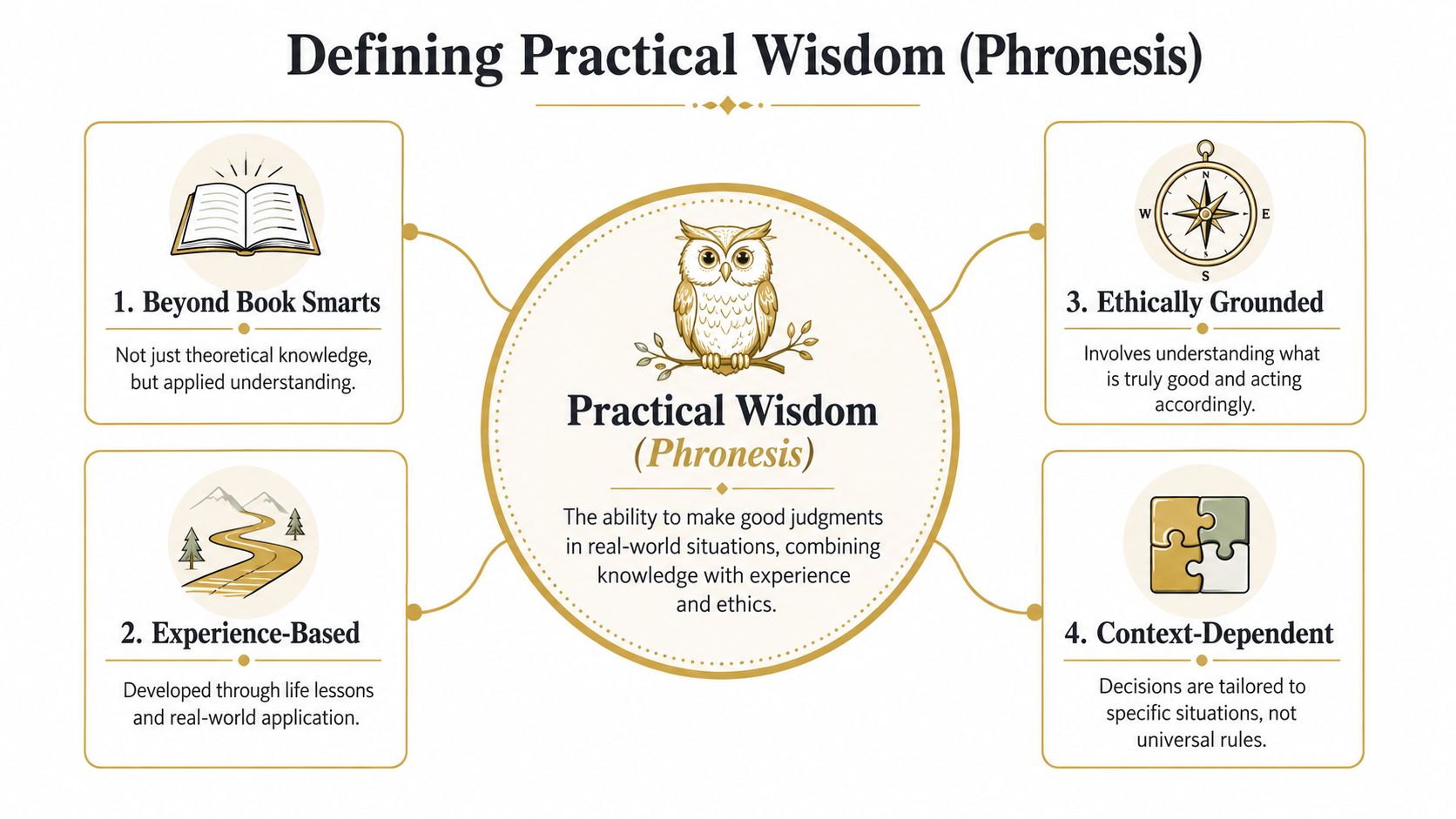
Practical wisdom is often called phronesis. In plain English, it means the ability to make good judgments in real life, not just in theory.
Think of the difference between someone who owns a stack of cookbooks and a chef who can rescue a meal when the sauce breaks, the oven runs hot, or a key ingredient is missing. The first person has instructions. The chef has judgment. The chef reads the situation, adjusts, and still serves something nourishing.
That’s what practical wisdom does in life.
Why information alone doesn’t help
Plenty of people can explain healthy communication and still handle conflict badly. Plenty of people can define boundaries and still collapse when someone is disappointed in them. That doesn’t mean they’re hopeless. It means information hasn’t yet become embodied judgment.
Research on wisdom in psychology describes practical wisdom as relying on social decision-making, emotional regulation, and self-reflection, and notes that experience by itself doesn’t guarantee wisdom. Development depends on reflection, tolerating conflicting viewpoints, and sensitivity to your own and others’ emotions, which supports judgment that considers the behavioral impact on others that goes well beyond one’s own personal considerations.
That line matters because practical wisdom is never just private cleverness. It includes consequences. It asks who is affected by your choice, not only whether the choice feels good to you.
The inner skills wisdom depends on
If you want a grounded definition, practical wisdom includes a few linked capacities:
- Clear perception: Seeing what is happening, not only what you hope is happening.
- Emotional steadiness: Feeling your emotions without letting them drive the car.
- Moral orientation: Caring about what is good, right, or least harmful in context.
- Context reading: Knowing that the same action isn’t right in every situation.
- Reflective learning: Looking back accurately so your past becomes instruction rather than repetition.
Practical rule: Wisdom doesn’t remove complexity. It helps you carry complexity without becoming reactive.
There’s also an old lesson here that still holds. Aristotle’s basic insight was that we become certain kinds of people by practicing certain kinds of actions. You don’t become wise by admiring wisdom. You become wiser by making better judgments, reviewing them, and trying again.
That’s why practical wisdom is less like a trait you either have or don’t have, and more like a capacity you strengthen. Some people start with better instincts. Still, everyone has to train perception, honesty, restraint, and courage in the mess of ordinary life.
Wisdom vs Intelligence Knowledge and Virtue
People often confuse wisdom with other admirable qualities. That confusion matters because if you aim at the wrong target, you can spend years developing something useful but incomplete.
A person can be brilliant and still choose terribly in love. A person can be informed and still lack timing. A person can care deeply about goodness and still act in ways that are clumsy, rigid, or harmful.
A side by side comparison
Here’s a simpler way to separate the terms.
| Concept | What It Is | Limitation Without Wisdom |
|---|---|---|
| Intelligence | The ability to reason, analyze, and solve problems | Can become detached from human nuance and real consequences |
| Knowledge | Facts, concepts, frameworks, and learned information | Can stay theoretical and fail under pressure |
| Virtue | A commitment to qualities like honesty, courage, justice, or compassion | Can become rigid or naive without context-sensitive judgment |
| Practical wisdom | The capacity to judge what is best in a specific situation and act accordingly | Requires continual practice, reflection, and honesty |
The key difference is application under real conditions.
Intelligence might help you spot five possible strategies. Knowledge might tell you the established best practice. Virtue might remind you to be kind and truthful. Practical wisdom decides how to speak the truth kindly, whether now is the right moment, what tone will preserve dignity, and when silence is avoidance.
What wisdom adds
Practical wisdom is the integrator.
It takes what you know, filters it through reality, and turns it into a response you can stand behind later. That’s why someone with modest academic credentials can sometimes handle life with far better judgment than someone with elite training. Real life is full of mixed motives, incomplete information, emotional charge, and competing goods.
A useful historical example comes from the wisdom of the crowd tradition. In the 1906 Plymouth country fair experiment, 800 participants guessed the weight of a dressed ox. The median guess was 1,207 pounds, which was within 1% of the true weight of 1,198 pounds. The lesson wasn’t that crowds are magically right. It was that good judgment often depends on how information is gathered and combined. Diversity, independence, and the right aggregation method matter.
That same principle shows up in personal decisions. More opinions don’t automatically make you wiser. The right reflection does.
- Intelligence without humility can rationalize bad choices.
- Knowledge without embodiment can sound impressive and change nothing.
- Virtue without nuance can become moral performance.
- Wisdom asks what serves truth, relationship, integrity, and reality together.
If you’ve ever wondered why a smart person keeps repeating the same destructive pattern, this is usually the answer. They have mental horsepower. They don’t yet have integrated judgment.
The Hidden Hurdle Why Wisdom Stays Out of Reach
Individuals rarely avoid wisdom because they love foolishness.
They avoid wisdom because wisdom requires seeing themselves clearly, and that is hard when old pain is still shaping perception. If your nervous system is primed for rejection, you won’t read a neutral moment neutrally. If you learned early that love must be earned, you may call self-abandonment generosity. If shame sits underneath your choices, you may mistake overexplaining for honesty.
Why self-perception breaks down
This is the part many conversations about wisdom leave out. They tell you to reflect. They tell you to be honest. They tell you to learn from mistakes. All of that is true, but it skips a brutal reality. Honest self-assessment is difficult when your defenses are protecting something tender.
A thoughtful critique of practical wisdom content puts it plainly. The development of practical wisdom “demands the capacity to perceive oneself, to assess what our own motives are, to accept and admit our failures”, yet much of the conversation ignores how unhealed trauma and shadow patterns obstruct the reflexivity required for wise judgment.
That gap is huge.
If you can’t see your motive, you can’t fully trust your conclusion.
This doesn’t mean every poor decision comes from trauma. It means self-awareness is not a simple switch. People protect themselves in elaborate ways. They intellectualize, spiritualize, minimize, idealize, dissociate, people-please, and blame. Often they do it while sounding insightful.
What shadow patterns do to judgment
Your shadow isn’t just the dramatic or unacceptable parts of you. It also includes the motives, fears, resentments, unmet needs, and hidden bargains you don’t want to acknowledge. Those buried dynamics distort decisions.
A few examples make this clearer:
- The rescuer pattern: You call it compassion, but you’re avoiding your own emptiness by fixing everyone else.
- The hyper-independent pattern: You call it strength, but you can’t receive support without feeling exposed.
- The peacemaker pattern: You call it maturity, but you’re scared of conflict and call your silence wisdom.
- The achiever pattern: You call it discipline, but your worth still rises and falls with approval.
None of these patterns make you bad. They make you human. But until they become conscious, they subtly steer your judgment.
That’s why practical wisdom and shadow work belong in the same room. You can’t choose well from a distorted inner map. Real discernment asks for emotional honesty, not just polished language.
A lot of personal growth stalls here. People keep searching for better advice when what they need is a gentler and more courageous look at the forces already driving them.
How to Cultivate Practical Wisdom in Daily Life
Practical wisdom grows through use. Not through perfect use. Through repeated use.
That matters because many people delay wise action until they feel fully certain, fully healed, or fully calm. Life doesn’t usually offer that luxury. You build wisdom by making the next more conscious choice, then learning from what happened.

David Blockley’s discussion of practical wisdom captures this well. Wisdom is not acquired through information alone. It is cultivated through experiential learning, and Aristotle’s point still lands cleanly: “people learn to be brave by doing brave things.” Practical wisdom grows through perception, mindfulness, deliberation, empathy, learning from past experiences, using emotions as our allies in real lived practice.
Start with a decision debrief
One of the simplest practices I recommend is a decision debrief. This is not rumination. It’s structured reflection.
After a meaningful choice, write down your answers to these questions:
- What happened? Stick to observable facts first.
- What did I feel? Name the emotions without editing them.
- What story was I telling myself? This reveals assumptions and fear.
- What value was I trying to protect? Safety, honesty, belonging, peace, control, dignity.
- What worked in how I responded?
- What didn’t?
- What would a wiser version of me repeat, stop, or try next time?
Do this after arguments, job conversations, dates, family interactions, and money decisions. Over time, patterns become hard to miss.
Use emotions as information
Many people make one of two mistakes with emotions. They either obey them instantly or distrust them completely.
Wisdom does neither. It listens first.
A useful test: Feel the emotion fully, then ask whether it is revealing a fact, a wound, a need, or a memory.
That single question can slow reactivity. Anxiety might be signaling genuine misalignment. It might also be old fear activated by healthy change. Anger might be exposing a crossed boundary. It might also be hurt wearing armor. Wisdom learns the difference.
Here’s a practical rhythm you can use in the moment:
- Pause your pace: Don’t answer the text, email, or request immediately if you’re flooded.
- Name the state: “I feel ashamed,” “I feel pressured,” “I feel defensive.”
- Check the body: Tight chest, clenched jaw, shallow breath, heavy stomach. Your body often knows before your narrative does.
- Delay the performance: You don’t need to produce a polished answer while dysregulated.
- Return to values: Ask what response matches self-respect and care for others.
A short teaching can help anchor that mindset:
Practice small acts of courage
Wisdom isn’t built only in dramatic crossroads. It’s built in ordinary repetitions.
Try a few small experiments:
- Tell one clean truth: Say what you mean without padding it with apology or overexplanation.
- Make one slower decision: Give yourself a night before agreeing to something important.
- Repair one miss: If you handled something poorly, circle back and own it.
- Ask one better question: Instead of “What should I do?” ask “What am I avoiding, and what matters most here?”
- Review one recurring pattern: Notice where your life keeps producing the same lesson in a different costume.
These are not flashy practices. They work because they turn wisdom into behavior.
Aligning Wisdom with Your Human Life Code
Self-knowledge becomes more useful when it’s specific.
That’s why many people are drawn to systems that help them recognize recurring themes in personality, relationships, and growth. A symbolic framework like numerology can offer language for the terrain you move through repeatedly. It may point to gifts that come naturally, pressures that keep surfacing, and life lessons that ask for maturity rather than escape.
Your pattern is not your prison
The important part is how you hold that knowledge.
A personal code, profile, or Life Path insight is not wisdom by itself. It’s a mirror. Sometimes a helpful one. Sometimes an uncomfortable one. But it does not choose for you.
If your pattern suggests difficulty with boundaries, wisdom is what helps you distinguish between compassion and self-erasure. If your pattern points to independence, wisdom helps you see when strength has hardened into isolation. If your pattern highlights sensitivity, wisdom teaches you how to honor feeling without letting feeling dictate every decision.
That’s the missing bridge in a lot of self-discovery work. People learn what they are prone to, but not how to respond skillfully when those tendencies show up in real time.
Where self-knowledge becomes wise action
Practical wisdom earns its place.
It helps you use any self-awareness tool responsibly. You stop treating identity language as a verdict and start using it as context. You ask better questions. Where am I most likely to distort reality? What old wound tends to hijack this pattern? What does maturity look like for me here? What action would respect both my nature and my responsibility?
That’s a much stronger approach than labeling yourself and calling it growth.
Practical wisdom keeps self-knowledge grounded. It asks whether an insight changes how you speak, choose, repair, love, rest, work, and set limits. If it doesn’t reach behavior, it may still be interesting, but it hasn’t become transformative.
The deepest value of any personal blueprint is not prediction. It is partnership. It helps you cooperate with your own development instead of fighting it blindly.
If you want a grounded way to explore your patterns and turn insight into real-life change, The Human Life Code offers tools that help you decode your Life Path, reflect on recurring challenges, and work with your gifts more consciously. It’s a thoughtful place to begin if you’re ready to pair self-discovery with wiser choices.