How to Calculate Life Path Number: 2026 Numerology Guide
You glance at your birth date all the time without really seeing it. It's on forms, passwords, reminders, old documents, maybe even stamped on a hospital bracelet tucked in a memory box. Then one day you wonder, could these numbers say something about the shape of my life?
That question is usually where numerology begins. Not with fortune-telling, but with curiosity. Your birth date becomes less like a random calendar fact and more like a starting coordinate. A pattern. A clue. In The Human Life Code way of thinking, it's the first key to decoding your personal blueprint so you can understand your gifts, your friction points, and the lessons that keep repeating until you finally see them clearly.
The good news is that learning how to calculate life path number isn't hard. The part that trips people up is using the right method and knowing when a number should stay as it is. Once that clicks, the math becomes simple, and the insight starts to feel personal in a whole new way.
Table of Contents
- What Your Birth Date Says About You
- Your Life Path Number The Simple Calculation
- What to Do with Master Numbers 11 22 and 33
- Life Path Number Calculations In Action
- Common Mistakes When Calculating Your Number
- You Have Your Number What Does It Mean
What Your Birth Date Says About You
A lot of people arrive here after noticing patterns in their life they can't quite explain. They keep ending up in the same kind of relationship. They're capable, but somehow still pulled between safety and purpose. They know they're meant for something, but the shape of it feels blurry.
That's where a Life Path Number can feel surprisingly grounding. It doesn't tell you what will happen. It gives you a language for understanding how you tend to move through life. Think of it as a symbolic blueprint, one that starts with the date you were born and opens a conversation about who you already are beneath the noise.

Some people discover their number and instantly feel seen. A person with a 1 may recognize why they've always felt pushed to lead, even when it was uncomfortable. Someone with a 7 may finally understand why solitude feels nourishing instead of lonely. A 6 may realize that caring for everyone else has been both a gift and a burden.
A small shift that changes the whole experience
Authentic value isn't in labeling yourself. It's in noticing patterns with more compassion.
Your birth date doesn't lock you into a fate. It gives you a mirror.
When you approach numerology this way, the calculation stops being a party trick. It becomes a practical first step in self-discovery. You're not asking, “What number am I?” You're asking, “What am I here to learn, strengthen, and mature through?”
That question matters because insight is most useful when it helps you make cleaner choices.
- In relationships, you may notice why certain conflicts repeat.
- In work, you may see where your natural energy flows easily and where it resists.
- In personal growth, you may get language for long-standing wounds, strengths, and blind spots.
The math comes first. Then the meaning starts to unfold. And once you know your number, you can use it as a steady reference point when life feels noisy, fast, or confusing.
Your Life Path Number The Simple Calculation
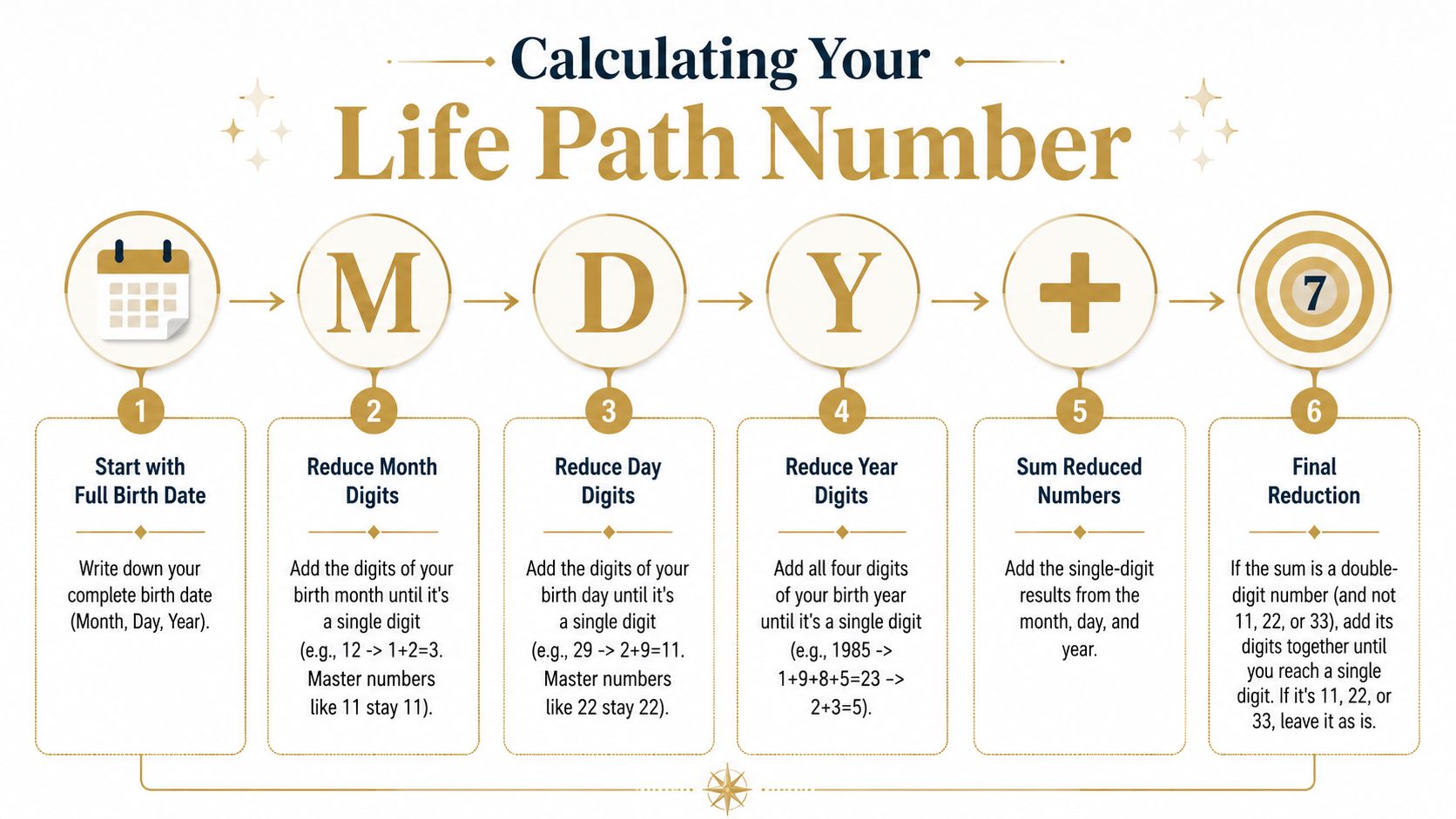
The most trusted way to calculate your Life Path Number is the Pythagorean method. It has been the dominant standard used by 85-90% of modern numerology practitioners, and it works by reducing the month, day, and year separately before adding them together, according to Numerology.com's explanation of Life Path meanings. That same source notes this separate reduction helps prevent errors that happen when people add the whole birth date in one long string.
Why the separate method matters
This is the part most online posts rush past. But it matters.
If your birthday is October 27, 1986, don't write all the digits in one line and start adding. Instead, take each piece of the date on its own:
- Month first: October is 10, so 1 + 0 = 1
- Day next: 27 becomes 2 + 7 = 9
- Year last: 1986 becomes 1 + 9 + 8 + 6 = 24, then 2 + 4 = 6
Now add those reduced parts together:
1 + 9 + 6 = 16
Then reduce again:
1 + 6 = 7
So the Life Path Number is 7.
Practical rule: Reduce the month, day, and year separately. Then add those results. If you hit 11, 22, or 33 at the right stage, keep them.
A napkin version of the math
If we were doing this over coffee, I'd tell you to treat this process as three small piles of numbers.
- Write your full birth date
- Reduce the month
- Reduce the day
- Reduce the year
- Add those three results
- Reduce the total unless it becomes 11, 22, or 33
A quick example:
| Birth date | Month | Day | Year | Total | Life Path |
|---|---|---|---|---|---|
| 06/24/1986 | 6 | 2+4=6 | 1+9+8+6=24, 2+4=6 | 6+6+6=18 | 1+8=9 |
That's it. Clean, simple, repeatable.
If you want to check your work against a tool, you can use a free Life Path Number calculator and compare each step to your handwritten math. That's especially helpful if you keep second-guessing whether a double digit should be reduced or preserved.
The deeper reason this matters is that the calculation itself reflects the philosophy behind it. Your month, day, and year each bring something different to the whole. You don't flatten them. You let each one speak first, then you listen to the combined result.
What to Do with Master Numbers 11 22 and 33
Master Numbers are where many people pause and think, “Wait, am I supposed to keep reducing this or not?”
Short answer: sometimes yes, sometimes no.

When to stop reducing
When 11, 22, or 33 appear at a key reduction step, you usually stop reducing them. Those are the classic Master Numbers in Life Path work.
That means if your day reduces to 11, you keep it as 11. If your final total becomes 22, you keep it as 22. If the final sum becomes 33, you keep it as 33.
Here's the clean rule set:
- Keep 11, 22, and 33 intact when they appear in the month, day, year reduction, or final total
- Reduce other double digits down to a single digit
- Don't reduce a Master Number out of habit just because you're trying to get everything down to one digit
This matters more than people think. According to ELLE's numerology guide, free online tools have seen over 50 million Life Path calculations since numerology became digitized, and 62% of users discover master numbers. That same source says users with a 33/6 Life Path show 35% greater interest in shadow work and personal growth content, which makes sense. These numbers tend to carry more intensity, responsibility, and inner pressure.
Why these numbers feel different
A Master Number is often read as a heightened version of its root energy.
- 11 carries the intuitive, sensitive tone of 2, but with more voltage
- 22 has the grounded building quality of 4, but on a larger scale
- 33 echoes the caring energy of 6, often with a stronger pull toward service
That doesn't mean a Master Number makes someone “better” or more evolved. It usually means the lessons can feel louder. The potential may be bigger, but so is the need for maturity.
If you want a visual walk-through before you calculate your own, this quick video helps clarify the rhythm of the process.
A Master Number is less like a trophy and more like an assignment. It asks for conscious use of your energy.
That's why people often feel relief when they learn the rule. The confusion lifts. The number that looked like a math error turns out to be the message.
Life Path Number Calculations In Action
Once you've got the rules, examples make everything click. Let's do the math in real time so you can compare it with your own birthday.
Example one a straightforward single digit
Take June 24, 1986.
Month: June = 6
Day: 24 → 2 + 4 = 6
Year: 1986 → 1 + 9 + 8 + 6 = 24 → 2 + 4 = 6
Now add them:
6 + 6 + 6 = 18
1 + 8 = 9
This person's Life Path is 9. Clean reduction, no master number, no extra wrinkle.
Example two a date with a master number
Now try February 29, 1984.
Month: February = 2
Day: 29 → 2 + 9 = 11
Year: 1984 → 1 + 9 + 8 + 4 = 22 → 22
Now add them:
2 + 11 + 22 = 35
3 + 5 = 8
So the Life Path is 8, but the calculation includes two strong master-number steps. That gives the reading more texture. You'd likely note those preserved values rather than ignoring them.
Example three a post-2000 birth date
Post-2000 dates can make people hesitate because of the zeros. Keep it simple and reduce normally.
Use May 27, 2002.
Month: May = 5
Day: 27 → 2 + 7 = 9
Year: 2002 → 2 + 0 + 0 + 2 = 4
Now add them:
5 + 9 + 4 = 18
1 + 8 = 9
No special trick. The zeros don't add confusion unless you overthink them.
One deeper layer you may notice
Some numerologists also track karmic debt numbers when they appear in the working math, especially 13/4, 14/5, 16/7, and 19/1. According to Seventh Life Path, this deeper approach is used by 85% of professional numerologists, and a 16/7 can point to lessons around betrayal or imbalanced relationships. The same source says 40% of basic online calculators miss this nuance.
That doesn't change your final Life Path number. It adds context.
Here's what that can look like:
| Birth date | Reduced parts | Sum | Final |
|---|---|---|---|
| 10/27/1986 | 1, 9, 6 | 16 | 7 |
In this case, the final result is 7, but the 16/7 pattern may matter in interpretation. If you've noticed repeated lessons in closeness, trust, or emotional self-protection, that extra layer can be useful. It can also bring more insight into relationship themes, especially when you compare patterns with a partner using tools like this guide to romantic relationship stages.
Common Mistakes When Calculating Your Number
Most mistakes happen because people rush the math or learned a shortcut that sounds easier but changes the result.
The mistake that changes everything
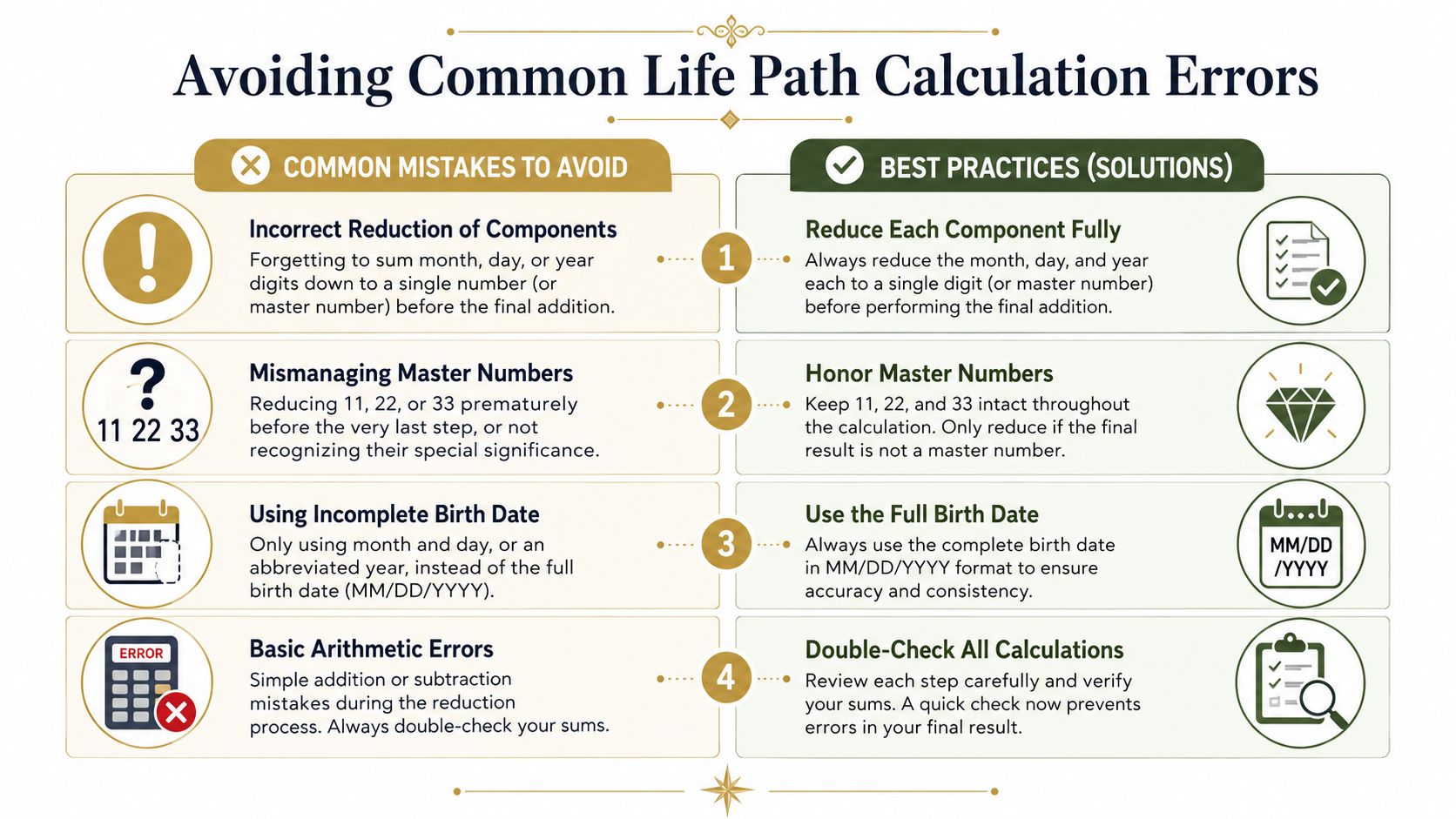
The biggest one is the single-sum method. That's when someone adds every digit in the birth date in one sweep instead of reducing the month, day, and year separately.
It seems harmless. It isn't. That shortcut can miss the shape of the original date, especially when master numbers appear along the way.
A few other common slips show up all the time:
- Reducing Master Numbers too soon: If you turn 11 into 2 or 22 into 4 before the right point, you lose a meaningful layer.
- Using a shortened year: You need the full year, not just the last two digits.
- Making tiny addition mistakes: One wrong sum changes the final number.
- Ignoring precursor numbers: If your calculation passes through something like 16/7, that detail may matter later.
Double-check the working, not just the answer. Most confusion hides in the middle steps.
The February 29 question
Leap year birthdays deserve their own mention because many guides skip them.
For February 29, the standard numerological approach treats the day as 29, which reduces to 11. That means you keep the day's master-number quality rather than shifting the birthday to March 1 or trying to “correct” it. According to AMC I Coding's numerology article, miscalculating leap day can skew results for the ~5 million people born on that rare date.
If you were born on February 29, use your actual date:
- Month: 2
- Day: 29 → 11
- Year: reduce normally
That's the cleanest way to honor the original birth imprint.
If your result still feels off, write the full equation by hand and read it line by line. Slow math is often the fix.
You Have Your Number What Does It Mean
Once you've done the calculation, you've got more than a digit. You've got a starting point for understanding your core wiring.
A 1 often points toward leadership, initiative, and the lesson of using independence well. A 5 tends to carry freedom, change, and the challenge of staying grounded while exploring. A 7 often leans inward toward analysis, reflection, and truth-seeking. A 6 usually brings themes of care, responsibility, and learning healthy boundaries.
That's where the work begins. Not in memorizing a list of traits, but in asking better questions. Where does this number already show up in my choices? What strengths am I underusing? What patterns keep asking for maturity?
A Life Path Number won't replace judgment, therapy, or lived experience. But it can give you a steady lens for self-observation. It can help you move from “Why do I keep doing this?” to “I see the pattern, and now I can work with it.”
If you want to keep going, a useful next step is comparing your birth-date code with your name-based numerology through a free name numerology calculator. That combination often adds depth, especially if your public self and private self don't feel like they match.
If you want a practical place to keep exploring your personal code, The Human Life Code offers tools for calculating your Life Path number, exploring meanings, and connecting those patterns to relationships, growth, and day-to-day choices.