Unlocking Romantic Relationships Stages
You might be here because something shifted.
A relationship that felt easy, magnetic, and almost effortless now feels a little confusing. Maybe you and your partner keep having the same argument. Maybe little habits suddenly bother you. Maybe you're wondering whether this is a rough patch, a sign of incompatibility, or just what real intimacy looks like when the sparkle settles.
That question is more common than people admit. Most of us get taught how to fall in love, not how love changes shape. And when nobody explains the map, normal relationship growth can feel like failure.
The good news is that romantic relationships stages are real, recognizable, and deeply human. Even better, they don't just tell you where you are. They can help you understand what your relationship is asking you to learn. And if you bring in a more personal lens, like Life Path numerology, you may start to see why certain stages feel easier for you while others hit a tender nerve.
Table of Contents
- Is This Normal? Making Sense of Your Relationship's Journey
- The Honeymoon High The Romance Stage
- When Reality Hits The Power Struggle Stage
- Finding Your Groove The Stability And Intimacy Stage
- Choosing Us Every Day The Commitment And Co-Creation Stage
- Your Personal Relationship Map A Numerology Perspective
- Embracing the Cycle of Relationship Renewal
Is This Normal? Making Sense of Your Relationship's Journey
You meet someone and everything clicks. Texts are effortless. Time flies. You both seem to want the same things. Then one night, something small turns into your first real fight. One of you wants more space. The other wants more reassurance. Suddenly you're not basking in chemistry. You're trying to decode tone, intent, and unmet needs.
That moment can feel unsettling because it challenges the fantasy that the right relationship should stay easy. But a shift from ease to friction doesn't automatically mean something is wrong. Often, it means the relationship is becoming real.
Psychologist Mark Knapp's model, first developed in 1978, gives us a helpful map of how closeness tends to grow through Initiating, Experimenting, Intensifying, Integrating, and Bonding, as described in this overview of Knapp's relationship stages from Psychology Today. What matters here isn't memorizing the labels. It's recognizing that love has phases, and each phase asks something different from you.
Why this feels so confusing
Early connection often runs on similarity. Later connection asks you to handle difference.
That means the very things you once brushed off can become emotional pressure points. One partner may think, "Why are they changing?" The other may think, "Why do I suddenly feel so sensitive?" Usually, neither person is broken. They're bumping into a normal developmental turn.
Most couples don't need more panic at this stage. They need a better map.
A lot of suffering comes from mislabeling growth as doom. If you think every disagreement means you've chosen the wrong person, you'll feel scared every time tension appears. If you understand stages, you can respond with more maturity and less drama.
A more personal way to read the map
Universal models explain the road. They don't always explain why two people experience the same road so differently.
You might move toward closeness fast but freeze when conflict appears. Your partner might stay calm in disagreement but struggle with vulnerability. That's where a personal lens can help. A framework like Life Path numerology doesn't replace psychology, but it can add language for your patterns, sensitivities, and growth edges.
If you've ever thought, "Why do I always get stuck here?" you're not asking the wrong question. You're probably asking a deeper one.
The Honeymoon High The Romance Stage
At the beginning, love can feel almost enchanted. You notice the way they laugh, the way they text, the way they reach for your hand. Even ordinary moments feel charged. That's not you being dramatic. That's your body and mind responding to a powerful bonding phase.

Why everything feels so intense
The Romance Stage, often called the honeymoon phase, is fueled by neurochemicals like dopamine that heighten attraction and focus. According to Dr. Jessica Higgins on the development of intimacy in relationships, this phase typically lasts an average of 18 months.
That helps explain why new love can feel so immersive. You may think about each other constantly. You may want to merge schedules, values, and future plans before you've fully learned each other's habits under stress. In this stage, people often feel a strong sense of "we-ness." You notice similarities more than differences, and giving comes naturally.
None of that is fake. It's just incomplete.
What this stage is really for
The romance phase has a job. It helps two people bond strongly enough to begin building trust, affection, and shared memories.
That foundation matters. It gives the relationship warmth to draw from later, when life gets less dreamy and more revealing. But this stage isn't supposed to last forever. If it did, you'd stay in idealization. You'd feel close, but not necessarily known.
A healthier way to view the honeymoon phase is this:
- Enjoy the chemistry: Let yourself feel the joy of connection.
- Stay curious: Notice how the person handles disappointment, stress, or waiting.
- Don't panic when it changes: The end of the high isn't the end of love.
- Build reality into the romance: Talk about money, family, boundaries, and daily habits.
Practical rule: The goal of early love isn't to prove you've found perfection. It's to create enough safety and goodwill for deeper truth to emerge.
Readers often get confused. They assume that if the butterflies settle, something is missing. But a relationship that evolves out of constant intensity may be doing exactly what healthy love is meant to do.
When Reality Hits The Power Struggle Stage
Then comes the part that catches many couples off guard.
You start seeing the edges of each other. One of you needs more alone time. The other wants more check-ins. You discover different conflict styles, different family conditioning, different ways of handling hurt. The relationship stops being a soft-focus mirror and becomes a real meeting between two separate people.
Why conflict shows up here
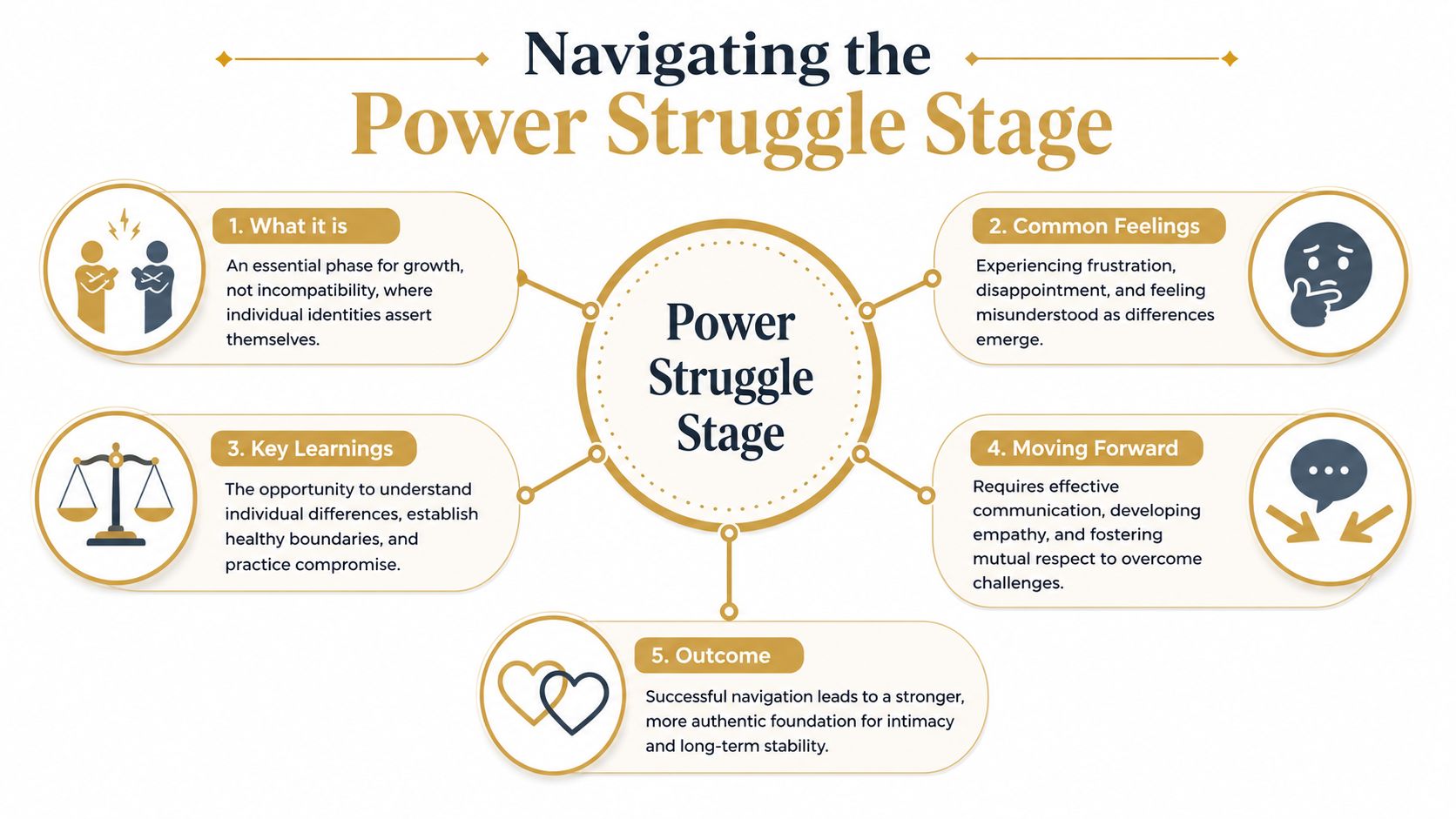
The Power Struggle Stage is not proof that love has failed. It's the stage where individuality comes back online.
A useful way to think about it is this. Two sovereign nations are trying to form a union. Both have laws, needs, fears, habits, and territories. Conflict isn't surprising. A central question is whether both people can stay connected while negotiating difference.
Dr. John Gottman's work offers one of the clearest practical markers here. According to Gottman's explanation of the three phases of love, couples who maintain a 5:1 ratio of positive to negative interactions during conflict have a 94% likelihood of staying together. That same body of work says mastering this stage predicts long-term success with over 90% accuracy.
That doesn't mean healthy couples never fight. It means they repair, soften, and reconnect often enough that conflict doesn't poison the bond.
Here are common signs you're in this stage:
- Repeating arguments: You keep circling the same issue in different clothes.
- Flaw visibility: Things you once found charming now feel irritating.
- Attachment fear: One or both of you start to wonder, "Will you be there for me?"
- Identity tension: Closeness starts to feel tangled up with control, freedom, or self-protection.
A lot of people exit relationships here because they mistake discomfort for incompatibility. Sometimes incompatibility is real. But often, this stage is where unhealed wounds finally get activated.
A short teaching video can help make that more concrete.
What healthy conflict actually looks like
Healthy conflict isn't neat. It's honest, regulated enough to stay respectful, and willing to return to repair.
Try this quick comparison:
| Pattern | What it sounds like | Where it leads |
|---|---|---|
| Reactivity | "You always do this." | Defensiveness and escalation |
| Vulnerability | "When that happened, I felt unimportant." | Clarity and connection |
| Scorekeeping | "I did this, so you owe me that." | Resentment |
| Repair | "We got off track. Can we start again?" | Safety |
If you're in this stage, these habits help:
- Lower the temperature first. Don't force resolution when both of you are flooded.
- Name the underlying fear. Under anger, there is often fear of rejection, control, or abandonment.
- Protect the bond while discussing the problem. Critique the issue, not the person's character.
- Look for repair attempts. A touch, a softer tone, a small joke, or "I see your point" can matter a lot.
During power struggle, the relationship isn't only asking, "Can you love each other?" It's asking, "Can you stay kind while being different?"
This stage is hard because it asks for maturity, not chemistry. But it's also where love becomes more honest.
Finding Your Groove The Stability And Intimacy Stage
After enough honest conversations, repaired ruptures, and reality-based choices, something steadier begins to form. The air feels different here. Less performative. Less anxious. More breathable.
This is the stage where love stops needing constant proof. You know each other better. You don't agree on everything, but disagreement doesn't feel like a threat to the relationship every time.

Clear-eyed love feels different
The romance stage says, "We're so alike." Stability says, "We're different in real ways, and we know how to live with that."
In Dr. Susan Campbell's model, the Power Struggle is where up to 69% of breakups occur, and moving successfully into Stability by learning to negotiate differences can reduce divorce risk by an estimated 30%, according to this summary of Campbell's relationship stages. That makes sense emotionally. Once two people stop trying to win and start trying to understand, the relationship becomes safer.
Stability doesn't mean boredom. It means your nervous system can rest more often.
Signs you are building secure intimacy
This stage usually looks ordinary from the outside, but it feels profound from the inside.
- Space doesn't equal danger: One of you can take a solo weekend, see friends, or focus on work without triggering a crisis.
- Team decisions feel natural: You talk through plans instead of forcing agreement.
- Vulnerability gets simpler: You can admit fear, shame, or need without as much armor.
- Your partner's limits feel real, not personal: You stop translating every boundary into rejection.
A stable relationship isn't one where nothing gets stirred up. It's one where both people know how to come back.
This kind of intimacy is often quieter than the early high, which is why some people miss it at first. It doesn't always feel cinematic. It feels grounded. You can laugh, be messy, have a hard week, and still trust the connection.
A simple distinction helps here:
| Romance stage love | Stability stage love |
|---|---|
| Idealized | Realistic |
| Intense and consuming | Warm and anchored |
| Similarity-focused | Difference-tolerant |
| Chemistry-led | Trust-led |
If you’ve reached this stage, don’t dismiss it because it feels less dramatic. Calm is not lack of passion. Very often, calm is what passion feels like once fear stops driving it.
Choosing Us Every Day The Commitment And Co-Creation Stage
There comes a point when love matures from “Do we work?” into “What are we building together?”
That’s commitment in its deeper form. Not just a label. Not just a ceremony. A lived decision to keep choosing the relationship with intention.
Commitment is a practice
Some people think commitment begins when the uncertainty ends. In real life, commitment usually begins when two people understand the reality and still say yes.
That yes has texture. It shows up in how you speak during stress, how you protect the relationship from contempt, how you revisit agreements, and how you make room for each other’s growth. In stage language, this overlaps with what some models call integrating and bonding. The important part is not the label. It’s the movement from closeness into shared purpose.
Commitment often means asking better questions:
- What kind of home are we creating?
- How do we want conflict to feel in this relationship?
- What values do we want our daily life to reflect?
- How do we support each other’s individuality while strengthening the partnership?
What co-creation looks like in real life
Co-creation sounds lofty, but it’s practical.
For one couple, it may look like raising children with more emotional awareness than either partner experienced growing up. For another, it may mean building a business, caring for aging parents, creating a peaceful household, or becoming a pair that contributes to community life in a grounded way.
Think of this stage as building a cathedral together. One person isn’t just laying bricks beside the other. Both people understand the structure they’re trying to create.
A few markers of co-creative love:
- Shared meaning: You have rituals, values, or goals that belong to the relationship itself.
- Mutual stewardship: Both people care for the bond, not just their own comfort.
- Flexible roles: You help where needed instead of clinging rigidly to fairness scripts.
- Long-view thinking: You make choices that protect the future, not just the mood of the moment.
This stage doesn’t erase struggle. It gives struggle somewhere to go. When conflict appears, it gets held inside a larger commitment.
Your Personal Relationship Map A Numerology Perspective
General stage models are helpful, but they can miss something important. Two couples can both be in the power struggle stage and still be living very different stories.
One couple keeps circling the same argument about space and closeness. Another gets stuck around money, leadership, or who gets the final say. A third looks calm on the surface, but both people have gone emotionally quiet. Same stage. Different lesson.
Universal stages personal patterns
That is where a personal lens helps. Life Path numerology gives you a way to read the pattern under the pattern.
It does not mean your relationship is predetermined. It means you may have certain default settings. Some people protect connection. Some protect freedom. Some protect safety by staying agreeable. Some protect themselves by taking charge. If you know your usual setting, the stage you are in starts to make more sense.
This can be quite relieving in the middle of a hard season. Many people assume, “We’re stuck because we’re wrong for each other,” when the deeper truth is, “This stage is pressing on an old sensitivity in me.” Numerology can help you name that sensitivity sooner, so you can work with it more consciously.
A few Life Path examples
A Life Path 2 often values harmony, emotional connection, and partnership. In the romance stage, this can feel warm and effortless. You may be the person who notices subtle mood shifts, remembers what matters to your partner, and wants the bond to feel close. The growth edge comes later. If keeping the peace becomes more important than telling the truth, resentment can accumulate.
A Life Path 8 often brings strength, direction, and a strong instinct to protect what matters. That can make a relationship feel grounded. But during conflict, the same strength can harden into control. If softness once felt dangerous, sharing power may feel far more exposed than it looks from the outside.
A Life Path 1 often values independence, self-trust, and forward motion. In love, that can bring courage and honesty. It can also make compromise feel confusing, especially if you learned to equate need with weakness. The lesson is not to become less yourself. It is to stay yourself while making room for a real “we.”
A personal relationship map works like a trail guide. The stages show the terrain. Your Life Path helps explain why certain parts of the trail feel easy, steep, or strangely familiar.
You can use that map in a few grounded ways:
- Notice your default defense. Do you move toward conflict, pull away, smooth things over, or try to take control?
- Connect the stage to the lesson. Romance can bring up boundaries. Power struggle can press on trust, pride, or fear. Stability can ask whether you know how to receive love, not just give it.
- Stop turning a pattern into a character judgment. A repeating issue does not mean you are bad at relationships. It often means the same wound keeps asking for care and honesty.
Your relationship stage shows where you are. Your personal code can help explain why that place feels so intense.
Psychology and spiritual tools support each other well here. Psychology helps you regulate your body, communicate clearly, and repair after conflict. Numerology adds another layer. It can show you the style of your lessons, so you meet them with less shame and more responsibility.
Embracing the Cycle of Relationship Renewal
Real relationships don’t move in a clean straight line. They loop.
A couple may feel stable for years, then a job loss, a new baby, grief, distance, illness, or personal awakening pushes them right back into tension. That doesn’t always mean the relationship is regressing. Sometimes it means a new layer is ready to be worked through.
That’s why it helps to see romantic relationships stages as a cycle of renewal, not a ladder you climb once. Romance can return. Power struggle can revisit. Stability can deepen. Commitment can become more conscious. Each pass through the cycle gives you another chance to love with more honesty.
If you’re in a confusing stage right now, try not to treat it like a final verdict. Treat it like information. Relationships grow when people learn how to read the moment they’re in, respond with skill, and understand their own patterns with compassion.
If you want a more personal lens on your relationship patterns, The Human Life Code offers tools to help you explore your Life Path, core dynamics, and growth edges in a grounded way. It’s a thoughtful place to go deeper if you’re ready to understand not just what stage you’re in, but why love tends to unfold the way it does for you.